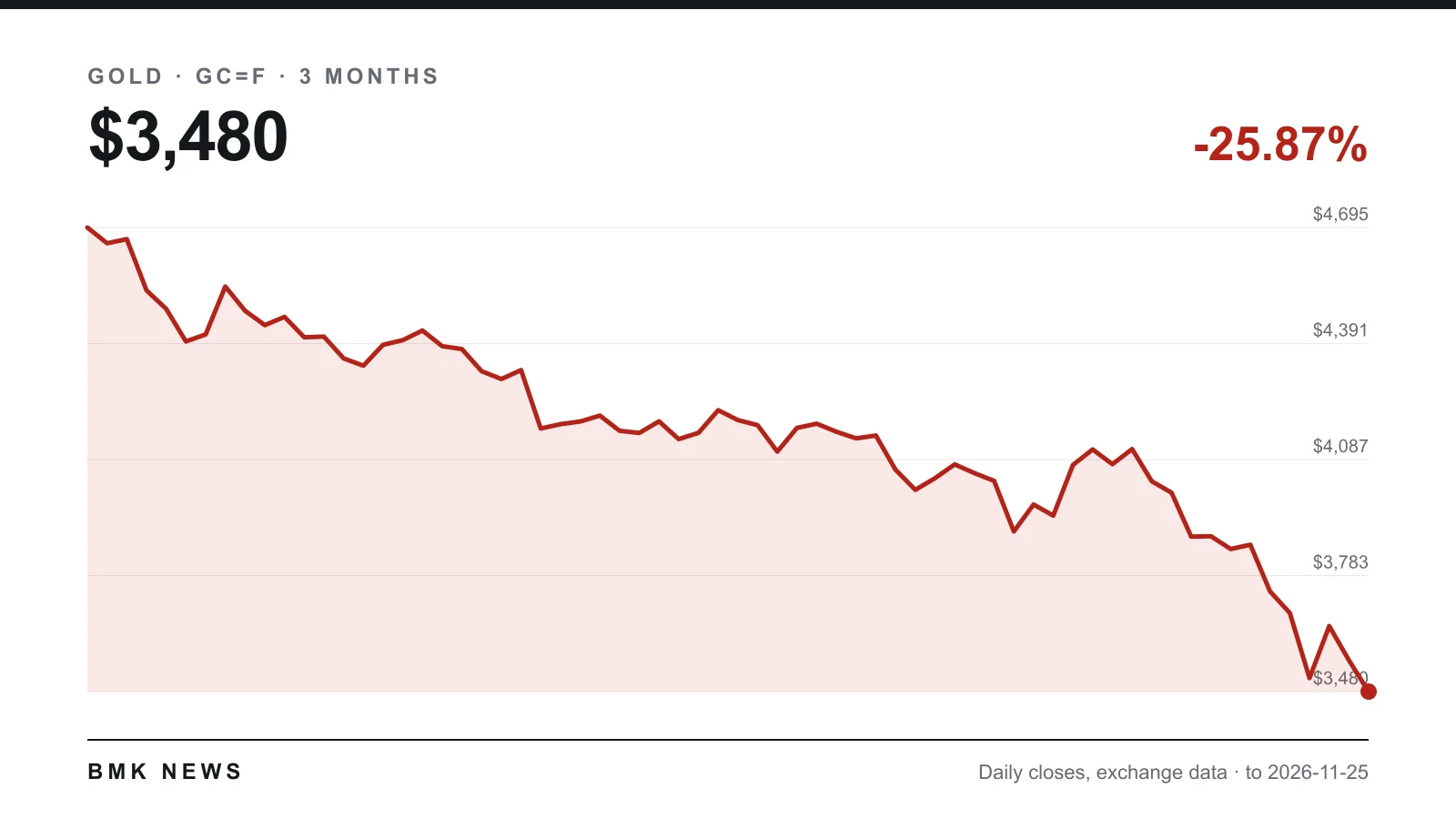
The gold price fell below $3,500 an ounce on Wednesday 25 November, its lowest in more than a year, according to Kitco. Only a day earlier, adviser Felix Zulauf had told Kitco the $3,500 area was "okay for a bottom". Spot gold traded near $3,450 just before 11:00 in New York, down about 3% and roughly 38% below its January record. Hot US inflation all but locked in a December rate hike, and the safe haven sank with stocks.
Gold's bad Wednesday, at 10:57 in New York
- $3,426.40 gold's lowest price of the day, according to Kitco
- 38% how far gold sits below its January record of around $5,600
- 3.3% US core PCE inflation in October, above the 3.2% economists expected
What you need to know
- Gold fell about 3% on Wednesday and slipped below $3,500 an ounce.
- Hot US inflation makes a Fed rate hike near certain, and gold pays no interest.
- The Fed announces its next rate decision on Wednesday 9 December.
Gold broke below $3,500 after US inflation came in hot
Gold slid through $3,500 on Wednesday morning, soon after a pile of US economic figures landed at 8:30 in New York.
The big one was PCE inflation, the price gauge the Federal Reserve watches most closely. Prices rose 3.8% in the year to October, up from 3.6% in September, the Bureau of Economic Analysis (BEA) said.
Core inflation, which leaves out food and energy, rose 3.3%. Economists had expected 3.2%, and Kitco said it was the most since 2023.
The rest of the data showed an economy running hot. Growth in the third quarter was revised up to a 4.3% annual pace, and new claims for jobless benefits fell to 189,000.
Even before the data, futures markets put the chance of a quarter-point Fed hike in December at about 96%, Kitco reported. By Tuesday, a December hike already looked near certain.
Silver fell even harder. It dropped more than 5% to about $38.60 an ounce, well below $40.
| Metal | Spot price | Move on the day | Day's range |
|---|---|---|---|
| Gold | $3,449.90 | -2.96% | $3,426.40 to $3,575.60 |
| Silver | $38.58 | -5.44% | $38.09 to $41.59 |
| Platinum | $1,221.00 | -3.93% | $1,216.00 to $1,295.00 |
| Palladium | $816.00 | -2.97% | $810.00 to $891.00 |
Prices at 10:57 in New York on Wednesday 25 November, according to Kitco.
Investors sell gold in a crash because they need cash fast
When share prices crash, many investors sell gold for one simple reason: it turns into cash quickly.
Wall Street had a brutal morning. Just before 11:00 in New York, the Nasdaq Composite was down about 4% and the S&P 500 more than 2.5%.
Some investors buy shares with money borrowed from their broker. When those shares fall, the broker demands more cash, which is called a margin call.
To raise that cash fast, people sell what they can. Gold has buyers at almost any hour, so it is often among the first things to go.
Felix Zulauf, who runs Zulauf Consulting and advises institutions and wealthy families, told Kitco that margin calls were one cause of gold's slide. Falling stocks forced borrowers to sell whatever they could.
Kitco also pointed to "broader liquidation across financial markets". In plain words: people selling almost everything at once. The same rush for cash drove last Friday's slide to a 14-month low.
Higher interest rates make gold costlier to hold
Gold pays no interest, so every Fed rate hike makes it look worse next to cash and bonds.
A savings account or a US government bond pays more when rates rise. A gold bar in a vault pays nothing, so holding it means giving up that income.
Kitco reported that bets on a tough Fed have pushed up the dollar and real yields, the return on bonds after inflation. Both make gold less attractive.
Zulauf called the bond market the second culprit. "What we saw this year was rising nominal and rising real rates, and that was the killer," he told Kitco.
The fall wipes out Monday's bounce back above $3,600 and more. Gold's high on Wednesday was about $3,576, according to Kitco.
What this means for you
Gold is not a perfect shield in a panic. In a sharp sell-off, it can fall alongside shares as people scramble for cash.
Anyone who bought near January's record is now sitting on a paper loss of almost 40%.
Higher rates cut both ways for households. Savers earn more on cash, while borrowers pay more, as our look at what more Fed hikes mean for mortgages and savings explains.
Gold mining shares usually swing harder than the metal. Our explainer on why gold miners fall harder than gold shows how a lower price eats into their profits.
Gold's next big test is the Fed decision on 9 December
The Fed meets on 8 and 9 December, and markets expect another rate rise. US markets close on Thursday for Thanksgiving and reopen for a short session on Friday.
Some analysts warn the selling may not be over. Roukaya Ibrahim, chief commodities strategist at BCA Research, sees a risk in gold ETFs, funds that hold gold bars for investors.
"Over the coming months, ETF flows are at risk of following prices lower, contributing to a further drop in prices," she told Kitco.
The World Gold Council's analysts are watching a lower level. If $3,500 gave way, they wrote on 23 November, the next place to look for a bottom was near $3,305, Kitco reported.
Others see a floor forming. Zulauf once lost half his money on a silver trade in 1980. On Tuesday he told Kitco the $3,500 area was "okay for a bottom". A day later, gold broke through it.
Iggy Ioppe, chief investment officer at Theo Network, told Kitco that some central banks buy gold on fixed budgets. Cheaper gold buys them more ounces. "The cure for low gold prices is low gold prices," he said.
The next date to watch is Wednesday 9 December, when the Fed announces its rate decision.
Why is gold falling today?
Gold fell about 3% on Wednesday 25 November because US inflation came in hotter than expected, making a December Fed rate hike almost certain.
Why does gold fall when the stock market crashes?
Gold often falls in a crash because investors sell it to raise cash quickly. Many need that cash to meet margin calls on money borrowed to buy shares.
What is gold's all-time high?
Gold's record high is around $5,600 an ounce, set in January 2026. On Wednesday 25 November it traded near $3,450, about 38% lower.
Sources
- Bureau of Economic Analysis: Personal Income and Outlays, October 2026
- Kitco: Gold, silver remain under pressure as strong GDP, sticky inflation reinforce Fed hike bets
- Kitco: Gold price approaches $3,500/oz after U.S. weekly jobless claims fall to 189k
- Kitco: Gold price falls to session lows as U.S. New Home Sales rise 14.2% in October
- Kitco: The silver trade that cost Felix Zulauf 50%, and why he says gold's fall is different
- Kitco: BCA Research ends four-year bullish gold trade as US dollar, Fed take their toll
- Kitco: Gold's selloff is sowing the seeds of its next rally, Theo's Iggy Ioppe
- Kitco: Live gold price
- Kitco: Live silver price
- Kitco: Live platinum price
- Kitco: Live palladium price