America's chipmakers sold off hard on Monday 16 November. The Philadelphia Semiconductor Index fell 5.28%, with every one of its 30 members lower, and dragged the Nasdaq Composite down 2.49% to 24,509.76. The rout came a day before Nvidia reports its quarterly results, with a new US export rule and the company's leadership crisis both on traders' minds.
Monday's sell-off in three numbers
- 5.28% fall in the Philadelphia Semiconductor Index, to 9,610.65
- 2.49% drop in the Nasdaq Composite, its third losing day in a row
- 24.05 session high for the VIX, Wall Street's fear gauge, after a jump of as much as 25%
Every chip stock in the index fell
The Philadelphia Semiconductor Index, known to traders as the SOX, tracks 30 US-listed companies that design, make or equip chips. On Monday not one of them rose, according to TradingKey's close-of-day report.
Micron, the memory maker, fell 7.62% and Intel 7.07%. The companies that sell machines to chip factories were close behind: Lam Research lost 6.68%, ASML 5.91% and Applied Materials 5.47%. AMD dropped 5.58%.
Nvidia itself fell 4.1%, CNBC reported. That came on top of a 13% slide the week before, which CNBC called the stock's biggest weekly fall since April 2025.
| Stock | Move on 16 November |
|---|---|
| Micron | -7.62% |
| Intel | -7.07% |
| Lam Research | -6.68% |
| ASML | -5.91% |
| AMD | -5.58% |
| Applied Materials | -5.47% |
| Nvidia | -4.1% |
| Texas Instruments | -3.09% |
Nvidia: share price, chart and news
Washington and Nvidia's boardroom added to the pressure
Two pieces of news hung over the day. The first came from Washington. The Bureau of Industry and Security, the part of the US Commerce Department that runs export controls, issued an interim final rule on remote access to advanced chips and servers. Its aim, the bureau said, is to make sure existing limits on sensitive American technology cannot be sidestepped through computing arrangements in data centres in third countries. CNBC reported that the loophole had let Chinese companies lease Nvidia's computing power. TradingKey said the tighter rules added to worries about Nvidia's business abroad.
The second came from Nvidia itself. Jensen Huang resigned as chief executive last week. A source told CNBC on Monday that the board is not discussing bringing him back, and Treasury Secretary Scott Bessent called over the weekend for a "dramatic shakeup" at the company.
"Two weeks ago investing in this name looked like a safe journey down a well-lit long hallway," Mike Mussio, chief investment officer at FBB Capital Partners, told CNBC. Now, he said, there are "several dark corners that people feel they need to peek around".
The selling spread well beyond chips
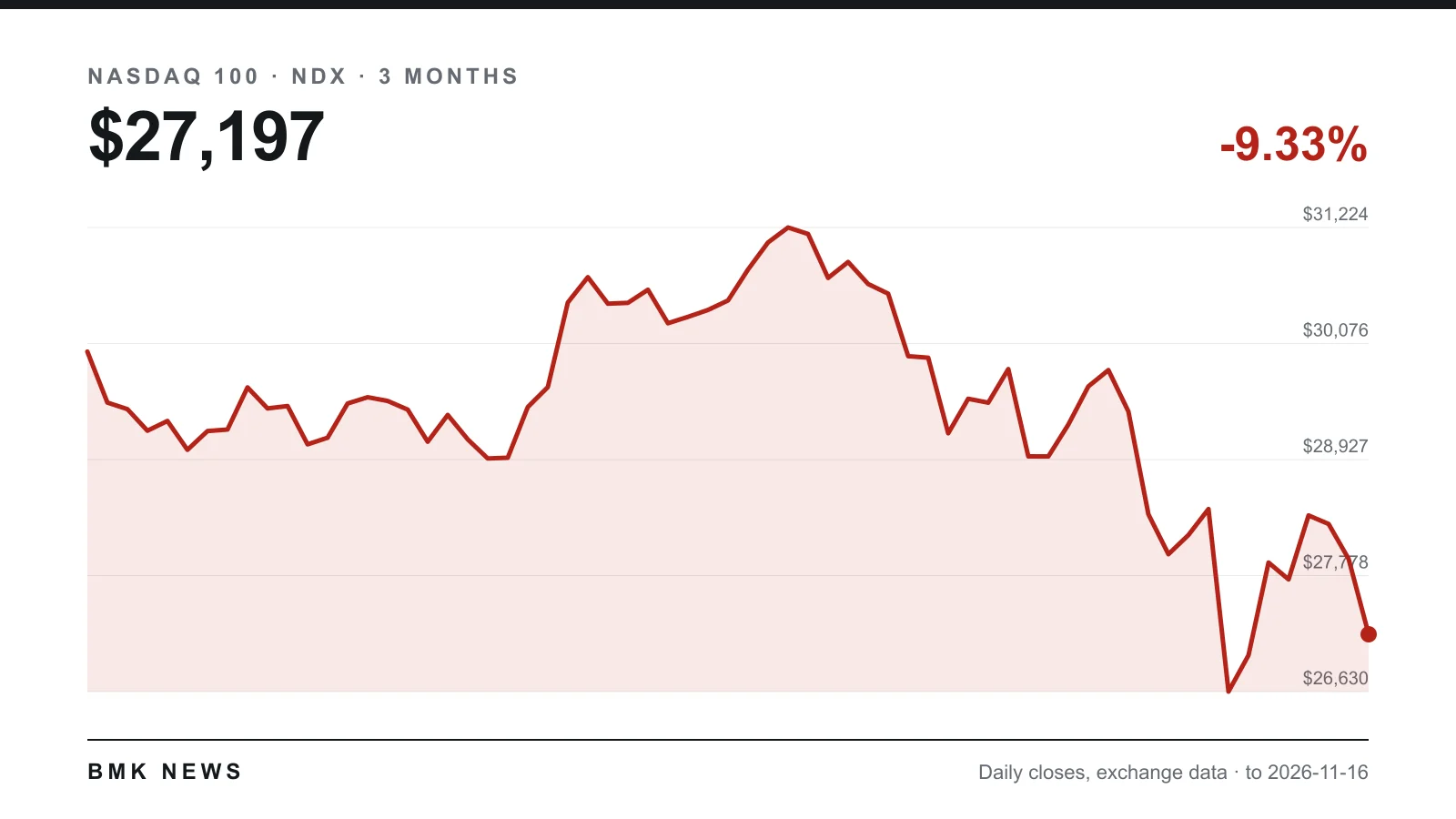
Three quarters of an hour into the session, at 15:15 GMT, the Nasdaq was down 1.39%, according to Sharecast. By the close the loss had grown to 2.49%.
Dell Technologies fell almost 7%, Sandisk about 8% and Oracle about 5%, CNBC reported. The big banks did not escape: Morgan Stanley, Goldman Sachs and JPMorgan Chase each lost more than 2%. The S&P 500 closed down 1.92% at 7,416.59 and the Dow fell 739.38 points, or 1.41%, to 51,608.17.
In afternoon trading, information technology was the S&P 500's worst sector, down 2.7%, followed by communication services, down 2.6%. Consumer staples, the makers of food, drinks and household goods, were the only sector in the green, up 0.3%, according to CNBC. The VIX, which measures how sharply traders expect the S&P 500 to swing over the next 30 days, reached its highest level in a week.
Monday at a glance
- Intel was already down more than 7% within the first hour of trading
- Washington published a rule on remote access to advanced chips
- Losses spread from chipmakers to hardware, software and the big banks
- The Nasdaq closed down 2.49%, the S&P 500 down 1.92% and the Dow down 1.41%
European markets, which close before Wall Street's afternoon, got off more lightly. The Stoxx 600 ended 0.3% lower at 662.31, Germany's DAX fell 0.6% and France's CAC 40 0.2%, according to Sharecast.
ASML: share price, chart and news
What it means for index-fund holders
The S&P 500 and the Nasdaq weight each company by its market value, and so do the funds that track them. So the biggest chip and technology names carry the most weight, and a day like Monday hits a plain tracker fund even if its owner never picked a chip stock. A fund tracking the S&P 500 would have lost roughly what the index lost, close to 2%.
Investors in Europe who hold US or global index funds in euros or pounds carry a second layer of risk: their return depends on both the share prices and the exchange rate with the dollar.
The next test comes quickly. Nvidia is due to report its third-quarter results after the US market closes on Tuesday 17 November. Analysts expect "near-triple-digit growth in both earnings and revenue", according to Sharecast. Wednesday's open will show whether the figures can steady the chip trade.
Questions and answers
Why did chip stocks fall on 16 November 2026?
Every stock in the Philadelphia Semiconductor Index fell as traders weighed a new US Commerce Department rule on remote access to advanced chips through overseas data centres and continued uncertainty over Nvidia's leadership after Jensen Huang's resignation, a day before Nvidia's results.
When does Nvidia report its third-quarter results?
Nvidia is due to report its third-quarter results after the US market closes on Tuesday 17 November 2026, according to CNBC and Sharecast.
How much did the Nasdaq fall on Monday 16 November?
The Nasdaq Composite fell 2.49% to close at 24,509.76, its third losing session in a row. The S&P 500 fell 1.92% and the Dow lost 739.38 points.
Sources
- CNBC: Nasdaq falls more than 2%, extending slide to third day as Nvidia drags down AI trade
- TradingKey: Dow Drops Over 700 Points With Tech as Main Drag, Nvidia Extends Slide by 4%
- Bureau of Industry and Security: BIS Issues Rule Addressing Remote Access to American Super Intelligence Technology
- Sharecast via Hargreaves Lansdown: US open: Stocks lower as investors eye Nvidia earnings, Anthropic IPO
- Sharecast via Hargreaves Lansdown: Europe close: Stocks fall ahead of Nvidia earnings