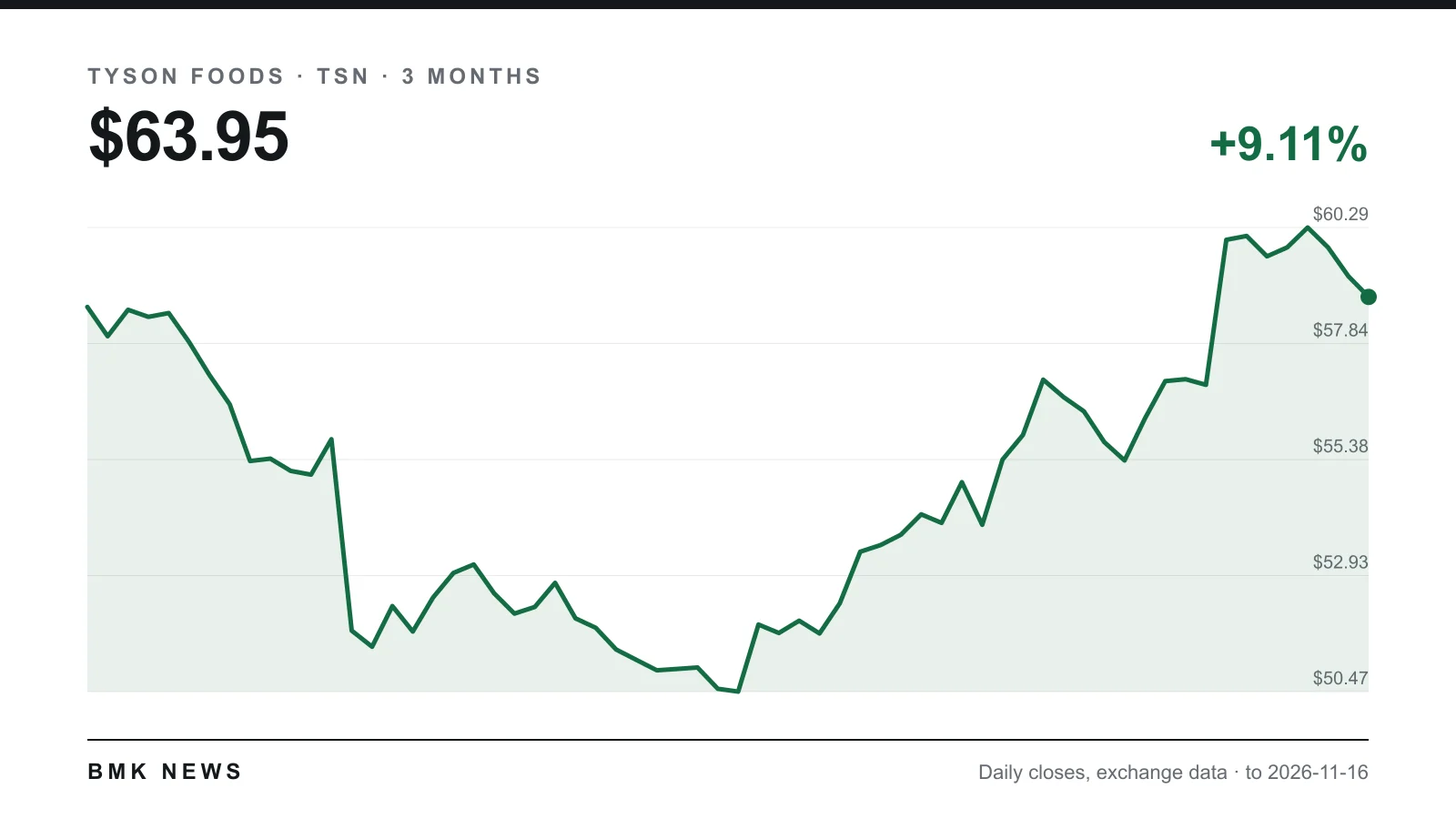
Tyson Foods swung to a $74m net loss in its fourth quarter, it said on Monday 16 November, as $254m of restructuring charges landed and adjusted earnings fell 47% to $0.61 a share. The shares still closed 8.7% higher at $63.95. Investors looked past the quarter to next year, when Tyson thinks its beef business, which lost $654m on an adjusted basis in fiscal 2026, could get back to break-even or even turn a small profit.
Tyson Foods, fiscal 2026 in three numbers
- $0.61 adjusted earnings per share in the fourth quarter, down from $1.15
- $654m adjusted operating loss in the beef segment for the full year
- $300m loss to $100m profit the range Tyson expects from beef in fiscal 2027
A weak quarter and a rally anyway
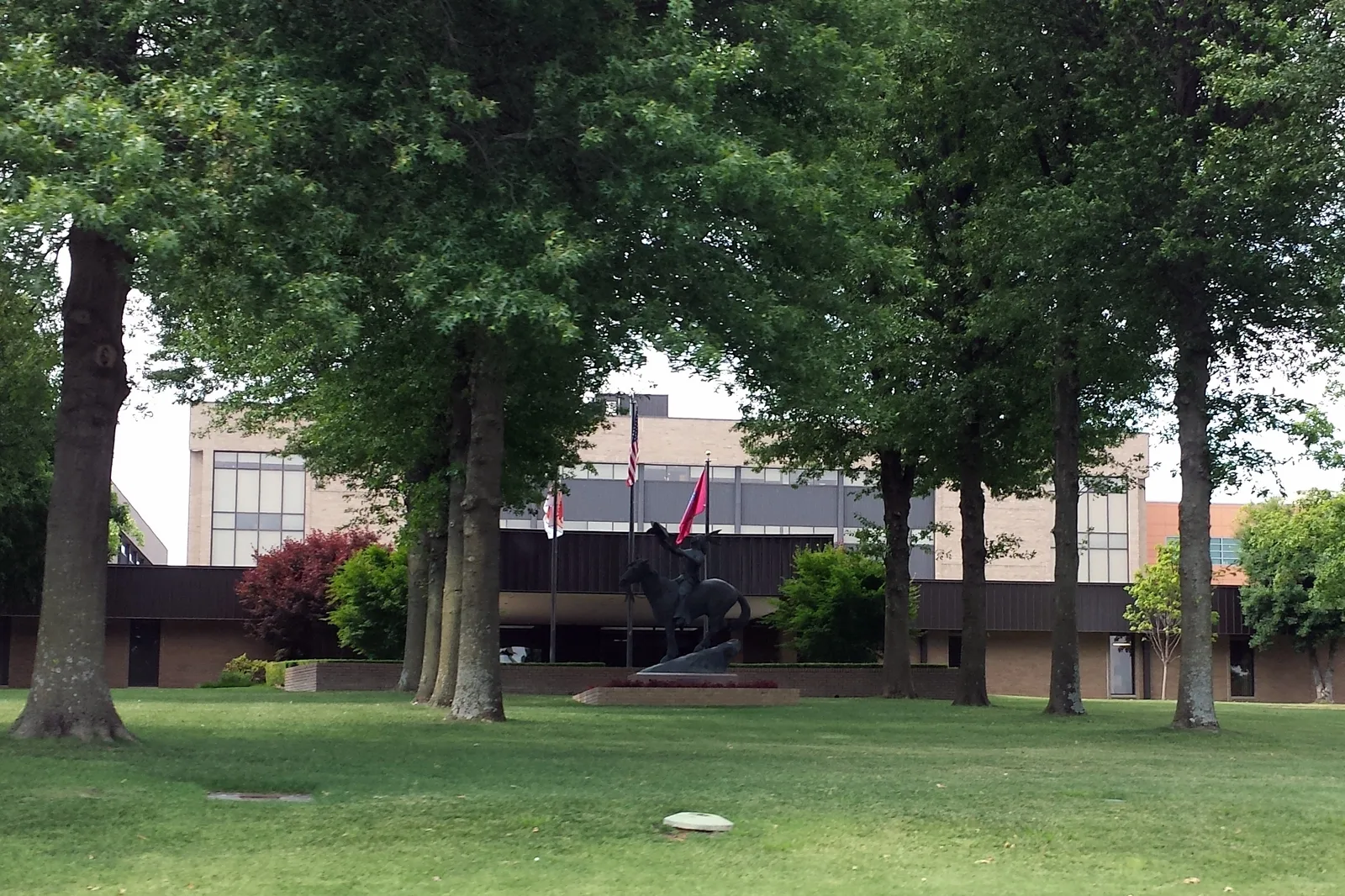
Tyson, the meat company based in Springdale, Arkansas, ran a 53-week fiscal year to 3 October, so its fourth quarter had 14 weeks instead of the usual 13.
The numbers were soft. Sales rose 5.2% to $14.6bn, but fell 4.0% once the extra week and legal accruals booked against sales are stripped out, the company said. Operating income, the profit from running the business before interest and tax, shrank to $1m from $158m a year earlier. The bottom line swung to a net loss of $74m, or $0.22 a share, from a $47m profit.
Most of the damage came from one-off costs. Tyson booked $254m of restructuring and related charges in the quarter, $230m of it in beef, plus $124m of accruals for legal claims. Excluding these and a few smaller items, adjusted earnings were $0.61 a share.
None of that stopped the buyers. The stock gained $5.13 to close at $63.95, according to the Arkansas Democrat-Gazette.
Fewer cattle, higher prices and a beef loss
Tyson's year was shaped by a shortage of cattle: ranchers have fewer animals to sell, which pushes up what meatpackers pay. In August, Tyson said it was reshaping its beef business "amidst one of the most historic cattle shortages the country has ever experienced."
Beef sales were almost flat at $21.7bn, because a 10.6% fall in the volume Tyson sold was offset by a 10.2% rise in the average price it charged. That did not cover the cost of the animals, and beef's adjusted operating loss more than doubled to $654m from $275m. In the fourth quarter alone the segment lost $171m on that adjusted basis.
Shoppers feel it too. The US Department of Agriculture's Economic Research Service expects retail beef and veal prices to rise 8.7% in 2026, well above its forecast of 2.8% for food prices overall.
| Segment | FY2026 adjusted operating income | FY2027 outlook |
|---|---|---|
| Beef | $654m loss | $300m loss to $100m profit |
| Pork | $228m | $75m to $175m |
| Chicken | $1.86bn | $1.3bn to $1.6bn |
| Prepared Foods | $1.33bn | $1.25bn to $1.4bn |
| International | $180m | $125m to $200m |
Why the beef outlook moved the shares
Management argued that the worst of the beef cycle is passing. "The challenges in our beef segment are a cattle cycle issue, not a broad deterioration in the business," chief operating officer Wes Morris told analysts, according to the Democrat-Gazette. He added that "as cattle costs ease and wholesale prices hold, packer margins are moving up from deeply negative levels."
Tyson has also shrunk its beef network to fit the smaller herd, ending operations in Joslin, Illinois, and Eagle Mountain, Utah, and seeking a buyer for its Pasco, Washington plant. Beef now centres on three large plants in Dakota City, Nebraska, Holcomb, Kansas, and Amarillo, Texas. On 9 November it announced its intent to form a long-term partnership with Allied Beef Company, a consortium of American ranchers, and said a second shift at Amarillo should be fully running by summer 2027.
Supply will not loosen quickly: the USDA projects US beef production will fall about 2% in fiscal 2027, Tyson said. Morris said heifer retention, ranchers keeping young females to breed rather than selling them for slaughter, is up about 3%, which "will tighten supply near term before it helps." The phased reopening of the Mexican border is a tailwind, he added, "although the start has been relatively slow."
Chicken carries the load, and the dividend rises
Chicken and prepared foods did the heavy lifting: chicken earned $1.86bn of adjusted operating income in fiscal 2026 and prepared foods $1.33bn. Tyson expects chicken to earn less next year, between $1.3bn and $1.6bn, while the USDA projects about 1% more US chicken production.
Overall, Tyson expects adjusted operating income of $1.7bn to $2.15bn in fiscal 2027, against $1.98bn this year, on sales 3.5% to 5.5% lower, mainly because it will sell less beef.
The board raised the quarterly dividend on Class A shares to $0.52, an annual rate of $2.08 and a 2% increase. It is payable on 15 December.
It was the first results call for chief executive Jeff Schomburger, who replaced Donnie King and was previously a senior executive at Procter & Gamble. He made the case for meat in plain terms: "Selling more laundry and diapers is hard. Selling more protein is fun."
What to watch next
- A formal deal with Allied Beef, so far only a stated intent
- A buyer for the Pasco, Washington beef plant
- The Amarillo second shift, due to be fully running by summer 2027
Questions and answers
Why did Tyson Foods stock go up on 16 November 2026?
Tyson closed 8.7% higher at $63.95 despite a $74m quarterly net loss, as investors focused on a fiscal 2027 beef outlook ranging from a $300m loss to a $100m profit.
Why is Tyson losing money on beef?
The US has a shortage of cattle, so meatpackers pay more for each animal. Tyson's average beef prices rose 10.2% in fiscal 2026, but volumes fell 10.6% and higher prices did not cover the cost of cattle.
Sources
- Tyson Foods: Tyson Foods Reports Fourth Quarter and Fiscal 2026 Results
- Arkansas Democrat-Gazette: Tyson Foods posts $74 million quarterly loss
- Tyson Foods: Tyson Foods Announces Network Restructuring for Beef Business to Strengthen Long-Term Performance
- Tyson Foods: Tyson Foods and Allied Beef Company Announce Plans to Establish a Long-Term Partnership to Strengthen Domestic Cattle Supply
- USDA Economic Research Service: Food Price Outlook, Summary Findings