BigBear.ai sells artificial intelligence software and services, mainly to US national-security agencies. Sales are growing again and the company has raised its forecast, but it remains loss-making, has written down the value of past acquisitions twice in two years and has issued a large number of new shares.
What BigBear.ai does
BigBear.ai Holdings is based in McLean, Virginia, and listed on the New York Stock Exchange under the ticker BBAI. Its website says it combines artificial intelligence with mission expertise to help decision-makers and operators act quickly. According to The Motley Fool's account of its October earnings call, management says it works at the application layer of AI and does not build data centres or its own foundation models.
Its offering spans several product lines:
- Generative AI: the BigBear Generative AI Platform, formerly Ask Sage, bought in December 2025, a security-focused workspace that gives users access to multiple AI models.
- Orchestration and sensor fusion: ConductorOS, which manages AI models and sensor data at the edge.
- Border and travel security: Pangiam threat detection for airport screening and CargoSeer for customs inspection of shipments.
- Modelling and simulation: digital twins, including Shipyard AI, and ProModel simulation software.
- Cybersecurity and analytics services for government customers.
BigBear.ai: share price, chart and news
A foothold in European airports
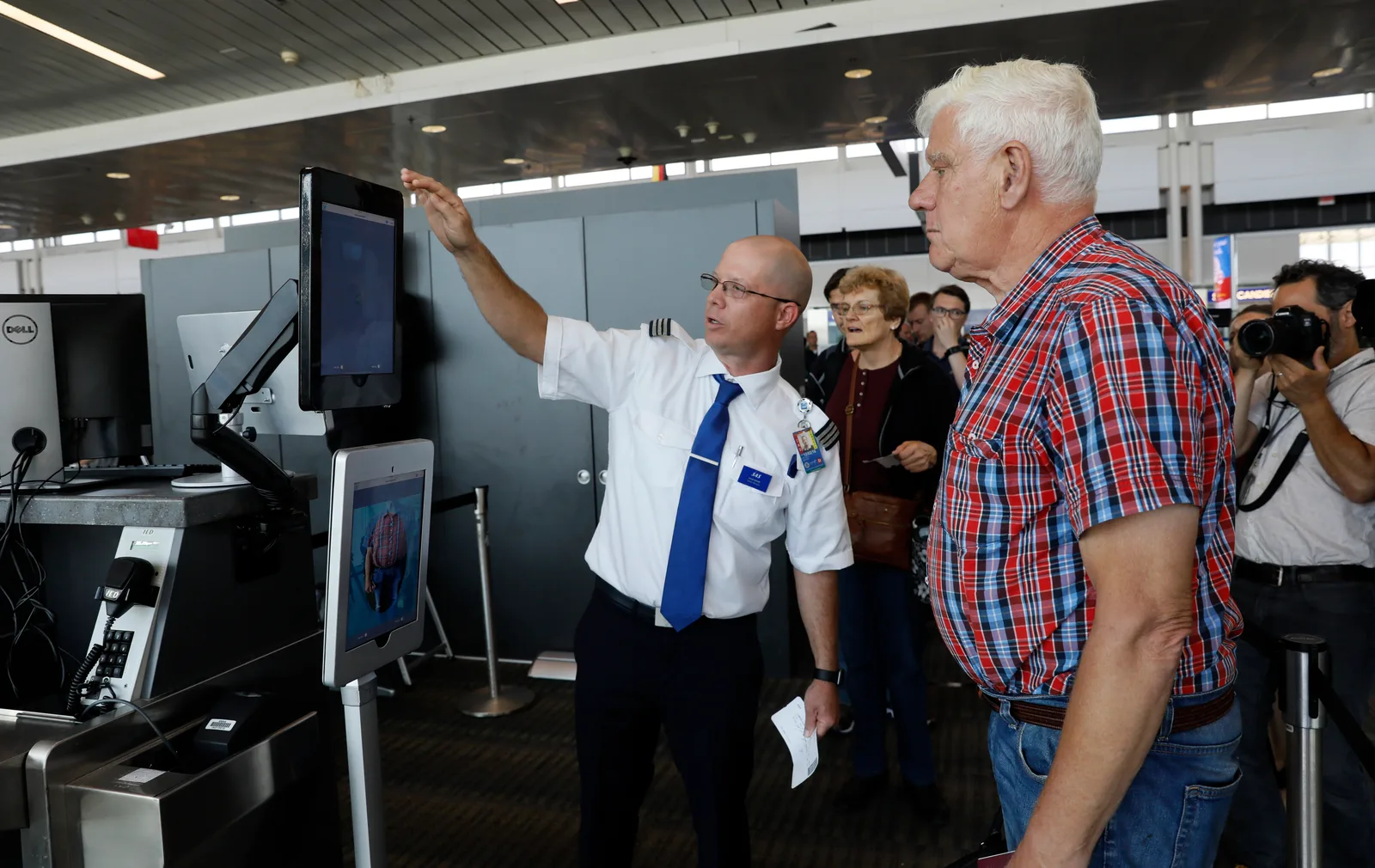
The newest development is in Europe. On 10 November BigBear.ai said its Pangiam threat detection software had been certified by the European Civil Aviation Conference (ECAC) for automated detection of prohibited items in cabin baggage, when used with SureScan's DETECT 1000 CT scanner. The company says the system meets the ECAC/EU APIDS Standard 1 and has been added to ECAC's list of compliant systems. ECAC has 44 member states.
The company says it is one of only two third-party software products on that list. It follows a Dutch approval for the same set-up, valid only in the Netherlands, announced in July 2026, and a round-the-clock trial at an unnamed major European airport. No airport customer has been named, so the certification opens a door rather than adding revenue. Chief executive Kevin McAleenan said reliance on automation "has to be earned through independent testing."
The latest numbers
Third quarter to 30 September 2026
- $43.6m revenue, up 31% year on year
- $330m backlog, about 23% funded
- $399m cash and investments
| Measure | Q3 2026 | Nine months 2026 |
|---|---|---|
| Revenue | $43.6m | $114.8m |
| Gross margin | 31.2% | about 32.6% |
| Goodwill impairment | $76.7m | $76.7m |
| Net loss | $91.9m | $174.4m |
| Adjusted EBITDA | -$9.1m | -$30.6m |
| Operating cash flow | -$9.6m | -$49.8m |
On 27 October the company raised its 2026 revenue forecast to $150 million to $165 million. On 13 October it said it had won more than $225 million of contracts since July, measured by total contract value, a figure that includes unexercised options and may never be fully funded. Named customers included the FBI, NASA, the US Coast Guard, the Department of Energy, the Department of Veterans Affairs and US Customs and Border Protection.
The $76.7 million goodwill impairment, which the company put down mainly to a change in its forecast, follows a $70.6 million charge in the first nine months of 2025. Goodwill on the balance sheet fell to $161.7 million.
Costs are growing almost as fast as sales. Selling, general and administrative expenses rose to $92.4 million in the first nine months from $69.5 million, and research and development to $18.5 million from $11.9 million. Part of the increase is amortisation and integration costs from the Ask Sage deal: $2.4 million and about $2.1 million respectively in the third quarter alone. The operating loss for the nine months widened to $152.8 million from $133.4 million.
The leadership team is led by chief executive Kevin McAleenan and chief financial officer Sean Ricker. The company has also appointed retired US Army Lieutenant General Sean A. Gainey to its board.
Cash, debt and shares
At 30 September BigBear.ai had $77.1 million of cash and $321.9 million of investments. Long-term debt was zero after its 2029 convertible notes were converted into shares, and $16.7 million of debt was due within a year. Total liabilities were $76.3 million against assets of $758.0 million.
The price of that cleaner balance sheet has been dilution. Shares outstanding rose to 480,428,208 at 30 September from 436,955,655 at the end of 2025, and the number of shares the company is allowed to issue was raised to one billion from 500 million.
Main risks
- Losses: the company lost $174.4 million in nine months and its adjusted EBITDA is still negative
- Government dependence: most revenue comes from US agencies, whose contracts are funded in stages and can be cut or ended
- Backlog quality: only about 23% of the $330 million backlog is funded
- Acquisitions: two large goodwill write-downs in two years show the risk in the value paid for past deals
- Dilution: the share count has risen sharply and authorised shares have doubled
What to watch next
| When | What to watch |
|---|---|
| December 2026 | Maturity of about $17 million of convertible debt; the finance chief said on the earnings call he expects to enter 2027 debt-free, The Motley Fool reported |
| Fourth quarter 2026 | Revenue of roughly $35 million to $50 million is needed to land inside the raised guidance, after $43.6 million in the third quarter |
| Ongoing | Whether the ECAC certification turns into named airport customers in Europe |
| Ongoing | How much of the $225 million of announced awards is funded and turned into revenue |
| Early 2027 | Full-year results and any 2027 outlook; no date has been announced |
Sources
- BigBear.ai: Third quarter 2026 results and raised FY 2026 revenue guidance (SEC filing), 27 October 2026
- BigBear.ai: Pangiam Threat Detection receives Europe-wide ECAC certification, 10 November 2026
- BigBear.ai: Secures more than $225 million in contract awards, 13 October 2026
- BigBear.ai: company website
- The Motley Fool via Webull: BigBear.ai, 3 key takeaways for long-term investors, 28 October 2026