AstraZeneca announced three regulatory approvals on Monday 16 November. Klygefa, a once-weekly injection that adults with generalised myasthenia gravis can give themselves, was cleared in both the US and the European Union, and US regulators approved a new Imfinzi regimen for bladder cancer that cut the risk of death by 42% in its main trial. The wins come as Farxiga, AstraZeneca's diabetes and heart drug, loses US sales to generic copies.
Monday's approvals in numbers
- 81,000 people in the US with AChR-positive generalised myasthenia gravis, the group Klygefa is approved for
- 42% lower risk of death with the new Imfinzi bladder cancer regimen in the VOLGA trial
- $795m Farxiga's US revenue in the first nine months of 2026, down 36% after generics arrived
A weekly injection for a disease that drains the muscles
Generalised myasthenia gravis, or gMG, is a rare autoimmune disease. The immune system attacks the junction where nerves pass signals to muscles, so muscles stop responding properly. It often starts with droopy eyelids, double vision or slurred speech, and can progress to trouble swallowing and, at worst, respiratory failure.
About 85% of patients carry antibodies against the acetylcholine receptor, known as AChR-positive, and these are the patients Klygefa treats. AstraZeneca estimates 98,500 diagnosed patients in the US, 81,000 of them AChR-positive, and 82,500 across Germany, France, the UK, Italy and Spain, about 66,000 of them AChR-positive.
Klygefa, or gefurulimab, comes from Alexion, AstraZeneca's rare disease arm. It blocks C5, a protein in the complement system, the part of the immune defences that turns on the body's own healthy cells in this disease. C5 blockers already exist. What is new is the format: Klygefa is a nanobody, a very small antibody-like molecule, that also latches on to albumin in the blood. That keeps it in the body longer, so one dose a week under the skin is enough.
Marc Dunoyer, chief executive of Alexion, called it "a first-of-its-kind treatment for gMG".
The trial behind the approvals
Both approvals rest on PREVAIL, a late-stage Phase III trial of 260 patients in 20 countries. Half received Klygefa and half a placebo for 26 weeks, and the main measure was the MG-ADL score, a scale on which patients rate how well they manage everyday tasks.
Patients on Klygefa improved by 1.6 points more than those on placebo, a result the company called statistically significant, with gains visible from the first week. The most common side effects were injection-site reactions (12%), back pain (8%) and vomiting (5%).
In Europe the drug is approved as an add-on to standard therapy, after the European Medicines Agency's medicines committee backed it in September. Japan approved it that same month, and filings are under review in China and other countries.
Imfinzi gains a third bladder cancer use
The US bladder cancer approval covers muscle-invasive disease, where the tumour has grown into the bladder's muscle wall but not spread to distant organs. Around 16,000 people in the US will be treated for it in 2026, according to AstraZeneca, and as many as half cannot take cisplatin, the standard chemotherapy, because of poor kidney function or other illnesses. For them, the usual answer has been surgery to remove the bladder, and the cancer often returns.
The new regimen gives three cycles of Imfinzi plus enfortumab vedotin before surgery, then nine cycles of Imfinzi alone afterwards. In the VOLGA trial, against surgery with or without approved follow-up treatment, it cut the combined risk of the cancer progressing, returning, the patient missing surgery or dying by 49%, and the risk of death by 42%. After two years, 78% of patients on the combination were alive, against 69%. The price was more side effects: severe ones, graded 3 or 4 from any cause, hit 64% of patients against 44%.
"As our third bladder cancer indication in two years, this approval reinforces Imfinzi as an immunotherapy backbone across muscle-invasive and non-muscle-invasive disease," said Dave Fredrickson, who runs AstraZeneca's oncology haematology business. Imfinzi brought in $5.5bn in the first nine months of 2026, up 28%. The regimen is also under review in the EU and Japan.
Farxiga's lost exclusivity is the backdrop
New medicines matter because old ones are fading. Farxiga lost US exclusivity this year, and several generic copies launched in the second quarter, according to the third-quarter report. Its US revenue fell 36% to $795m in the first nine months, and global Farxiga revenue fell 12% to $5.6bn.
The group is still growing. Total revenue rose 7% at constant exchange rates to $46.9bn over the nine months, as double-digit growth in oncology, respiratory and immunology, and rare disease offset losses at Farxiga and the heart drug Brilinta. Chief executive Pascal Soriot said in October that the company was "on track to deliver our 2030 ambition".
Writing on Monday, AJ Bell's investment director Russ Mould said the news lends credibility to Soriot's target of "launching 20 new medicines by 2030", and described the market reaction as measured, with some approvals already priced in.
Sales jobs go as money moves to research
AstraZeneca has reportedly cut about 600 jobs in its US respiratory and immunology sales teams to shift resources towards its drug development pipeline, according to a Bloomberg report cited by Newsquawk. Some of the people affected marketed the asthma treatments Breztri and Airsupra.
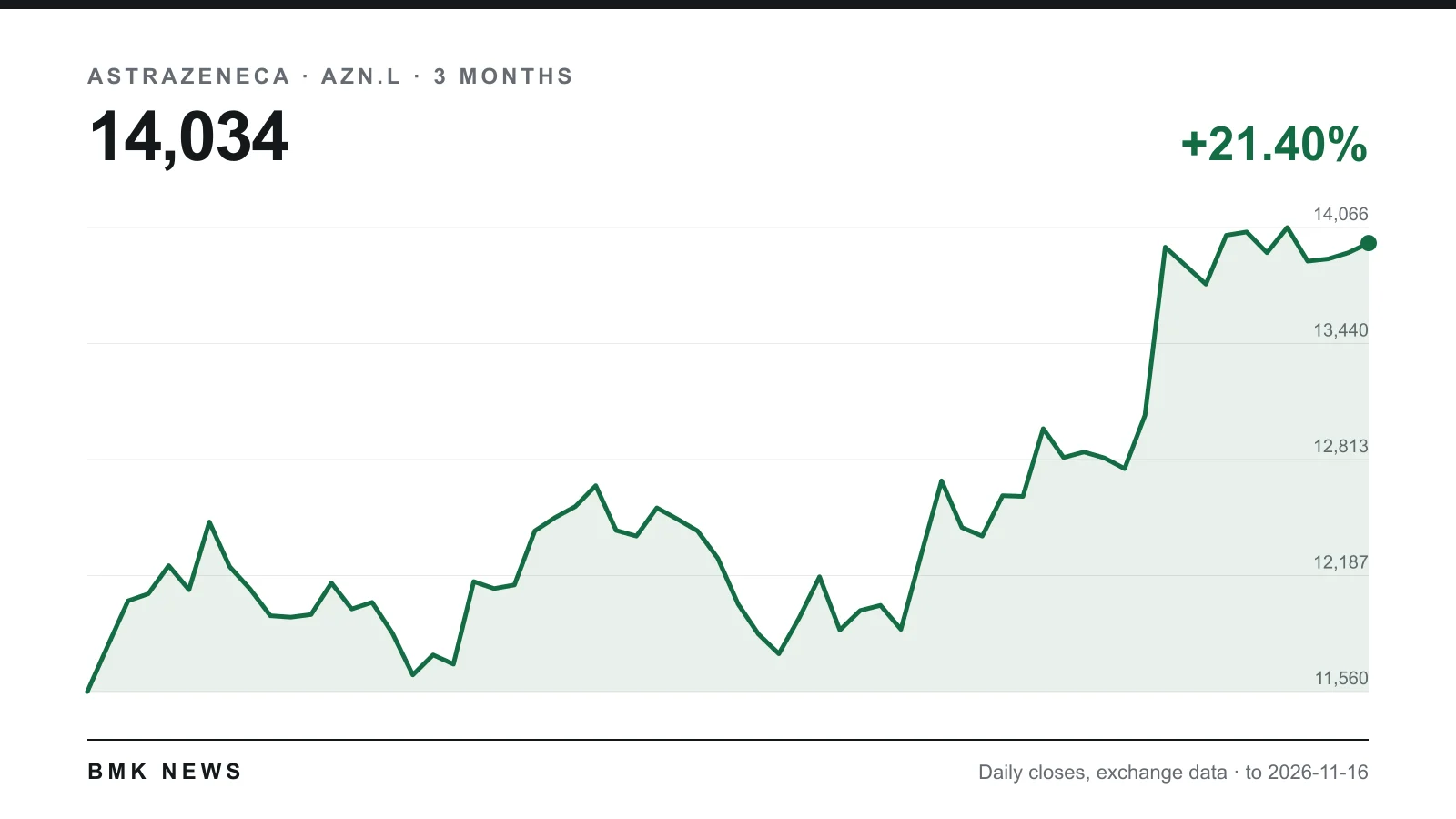
AstraZeneca: share price, chart and news
Questions and answers
What is Klygefa used for?
Klygefa (gefurulimab) treats adults with generalised myasthenia gravis who carry antibodies against the acetylcholine receptor. Patients inject it themselves once a week with an autoinjector, and it works by blocking the C5 complement protein.
Is Klygefa approved in Europe?
Yes. On Monday 16 November 2026 AstraZeneca announced European Commission approval of Klygefa as an add-on to standard therapy for AChR-positive adults, alongside US approval. Japan approved it in September.
Why is AstraZeneca cutting US sales jobs?
According to a Bloomberg report cited by Newsquawk, AstraZeneca cut about 600 US respiratory and immunology sales jobs to move resources towards drug development.
Sources
- AstraZeneca (RNS via Investegate): Klygefa (gefurulimab) approved in the US
- AstraZeneca (RNS via Investegate): Klygefa (gefurulimab) approved in the EU
- AstraZeneca (RNS via Investegate): Imfinzi + EV approved in US in bladder cancer
- AstraZeneca (RNS via Investegate): 3rd Quarter Results
- Newsquawk: Newsquawk Daily European Equity Opening News - 16th November 2026
- AJ Bell: Daily market update: Legal & General, AstraZeneca, Nvidia