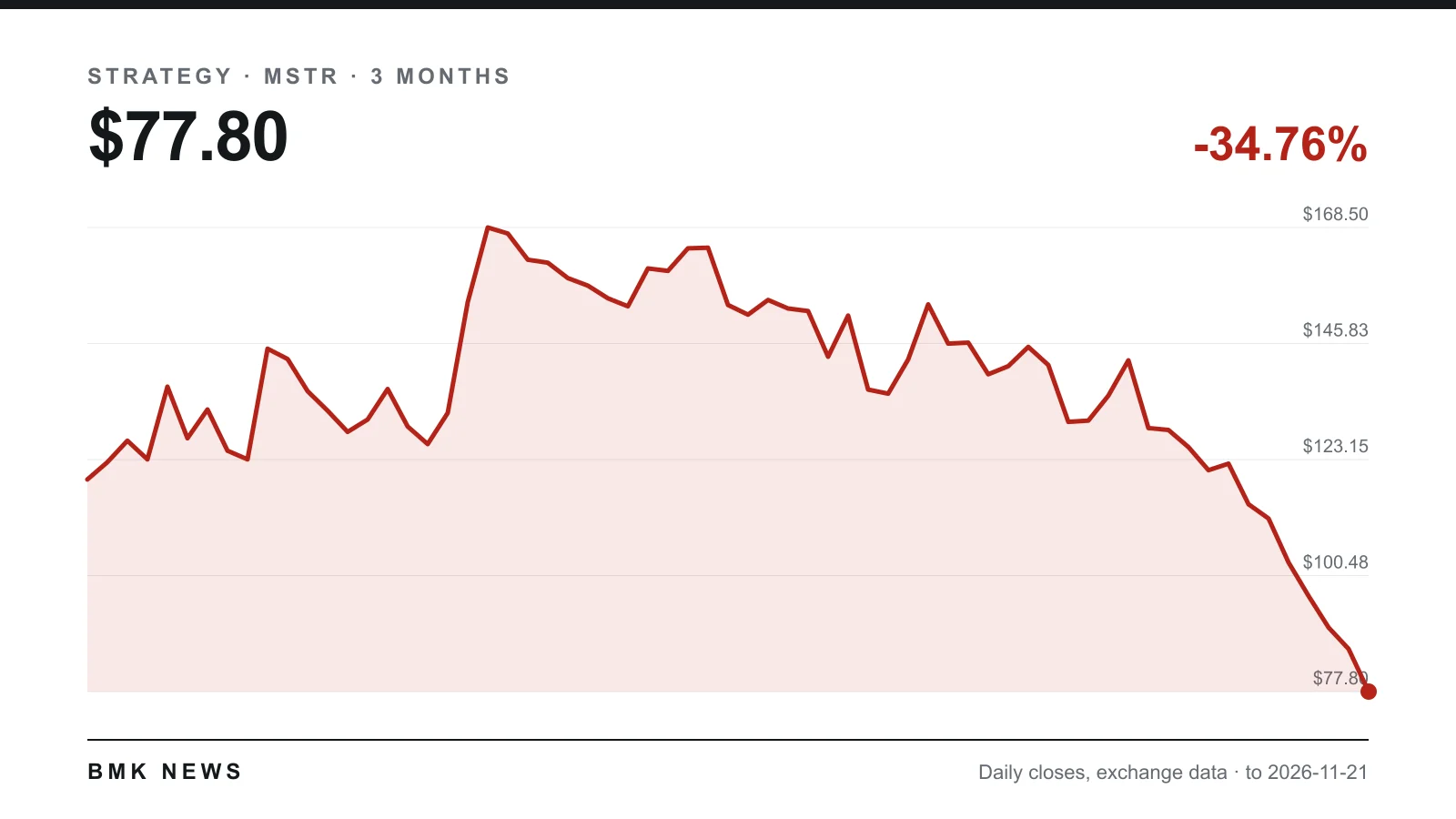
Strategy, Michael Saylor's bitcoin-buying company, leaves MSCI's global indexes at the close on Monday 30 November, and it heads for the door after losing 30% in a single week. Funds tracking MSCI held about 13 million of its shares by Strategy's own estimate, roughly $1bn at Friday's $77.80 close, and on Thursday Saylor said the company could even sell bitcoin to defend its 12% STRC preferred.
Strategy's road out of MSCI
- 30.3% MSTR's fall in the week to Friday 20 November, to $77.80
- 13m Strategy shares held by MSCI trackers, by the company's August estimate
- $5bn the size Saylor says STRC could shrink to, from about $7.7bn
Why MSCI is removing Strategy from its indexes
MSCI's November index review, published on Wednesday 11 November, deletes 100 securities from the MSCI ACWI Index, with every change made "as of the close of November 30, 2026". Strategy is among them, leaving MSCI's Global Investable Market Indexes, including the flagship MSCI USA Index, investingLive reported.
This is the first review under a rule for "non-operating companies" that MSCI finalised on 15 October. The test looks at a company's operating assets, then at five financial ratios; fail at least four and the company can be ruled ineligible. Existing members are normally removed only after failing in two annual reporting periods, yet Strategy went straight onto the deletion list. In plain terms, MSCI decided that the largest corporate holder of bitcoin looks more like an investment fund than an operating business.
Strategy had also failed an asset-neutral version of the test in August, and a simulation on May data flagged Japan's biggest listed bitcoin holder, Metaplanet, and the uranium holder Yellow Cake too. SharpLink sits on a watch list. Saylor has called the rule discriminatory and argues that Strategy runs a genuine software business.
How much Strategy stock index funds hold
Strategy said in August that funds tracking MSCI indexes held about 13 million of its shares, around 3.1% of its basic shares outstanding and less than one day's normal trading. That was its own estimate, not a figure for what the funds will sell. JPMorgan analysts once put the forced selling at about $2.8bn, though that sum was worked out for an earlier, crypto-specific MSCI proposal, Bitcoin.com News reported.
The wait has been expensive. This is what that block has been worth since the eve of MSCI's decision:
| Date | MSTR close | Value of 13m shares |
|---|---|---|
| Tuesday 10 November | $121.07 | $1.57bn |
| Friday 13 November | $111.62 | $1.45bn |
| Tuesday 17 November | $96.50 | $1.25bn |
| Friday 20 November | $77.80 | $1.01bn |
Friday's close was Strategy's lowest since February 2024, according to Bitcoin.com News.
The trade may matter less than what follows. Strategy pays for much of its bitcoin by selling new shares, and a thinner base of index holders could make that equity dearer to issue, especially if other index providers copy MSCI, investingLive noted.
What Saylor said about selling bitcoin to defend STRC
STRC is Strategy's perpetual preferred share: it never matures, pays a variable dividend that the company has kept at 12% a year for December, and is meant to trade near its $100 stated amount. It slipped below $100 this week, closing at $96.11 on Wednesday 18 November after more than $600m of it changed hands in a day.
At Strategy's investor Q&A on Thursday evening, 19 November, Saylor said he was prepared to take STRC from about $7.7bn "all the way down to $5 billion if need be", buying it back in what he called a "gentle, continuous auction". He put demand at about $7bn, down from $10.5bn six months earlier, and refused to lift the dividend to 15% or 20%. "We're playing the long game. We're not playing the fastest growth game," he said, according to Bitcoin.com News.
The usual way to fund those buybacks is to sell new MSTR shares. Saylor's example was selling stock at 0.98 times mNAV, the ratio of Strategy's market value to its bitcoin, to buy STRC at $95. Below that level, he said, Strategy "can even sell bitcoin to buy STRC". From a company built on never selling, that is a striking line. The shift is already visible: in the week to 15 November Strategy bought just 485 bitcoin for $33.4m but spent $228.1m buying back STRC, $206.3m of it paid for by selling MSTR shares, a filing showed.
Bitcoin is trading below Strategy's average cost
After that purchase Strategy held 850,849 bitcoin, bought for about $64.20bn, an average of $75,452 a coin. After Friday's slide below $60,000, bitcoin fell to $55,081 on Bitstamp at about 7am Central European Time on Saturday, then climbed back to about $60,000 by 7pm. At $60,000 the holding is worth about $51.1bn, roughly $13.1bn less than Strategy paid. At Saturday's low the gap was about $17.3bn.
Saylor argued the balance sheet is sturdier than the last time bitcoin traded near these prices. Strategy now has about 3.4 years of dollar cover for its dividends, against 0.7 years back then, and its latest filing showed a $4.75bn reserve for preferred dividends and debt interest as of 15 November, Bitcoin.com News reported. The pain spread far beyond crypto: on Friday the S&P 500 slipped into correction territory.
What to watch before the 30 November close
Strategy's next weekly update, for 16 to 22 November, will show what it did with a week of falling prices.
Three things to watch
- Strategy's update for the week to 22 November, and whether it sold any bitcoin
- Whether STRC can climb back towards $100 while the dividend stays at 12%
- The index trade itself, at the close on Monday 30 November
MSCI has said its results may still be updated before the change takes effect. If they stand, other bitcoin treasury firms, such as a London-listed bitcoin treasury company, will have a first real example of how the rule bites.
When will Strategy be removed from MSCI indexes?
Strategy leaves MSCI's global indexes, including the MSCI USA Index, at the close on Monday 30 November 2026, when the changes from MSCI's November index review take effect.
Why is MSCI removing Strategy (MSTR)?
Strategy failed MSCI's new test for non-operating companies, finalised on 15 October 2026, which screens out firms that look more like investment funds than operating businesses.
Will Strategy sell bitcoin?
Strategy has not announced any bitcoin sale. On Thursday 19 November 2026 Saylor said it could sell bitcoin to buy back its STRC preferred if its shares trade below about 0.98 times the value of its bitcoin.
Sources
- MSCI: MSCI Equity Indexes November 2026 Index Review
- investingLive: Strategy (MSTR) is to be removed from MSCI Global Investable Market Indexes following MSCI's implementation of a new non-operating company rule
- Bitcoin.com News: MSCI Rules on Strategy Today and Billions in Forced Selling Hang on It
- Bitcoin.com News: Bitcoin Giant Strategy's Shares Could Drop 75% to $23 Amid Bearish Pattern: Analyst
- Bitcoin.com News: Bitcoin Giant Strategy Will Keep Buying STRC Below $100 After $600M Day: Saylor
- Bitcoin.com News: Saylor Says Strategy Could Shrink STRC to $5B and Even Sell Bitcoin to Defend It
- Bitcoin.com News: Strategy, Coinbase Shares Battered as Bitcoin Price Hits 2-Year Low and AI Stocks Bleed
- Bitstamp: BTC/USD hourly prices
- Coinbase: BTC-USD spot price