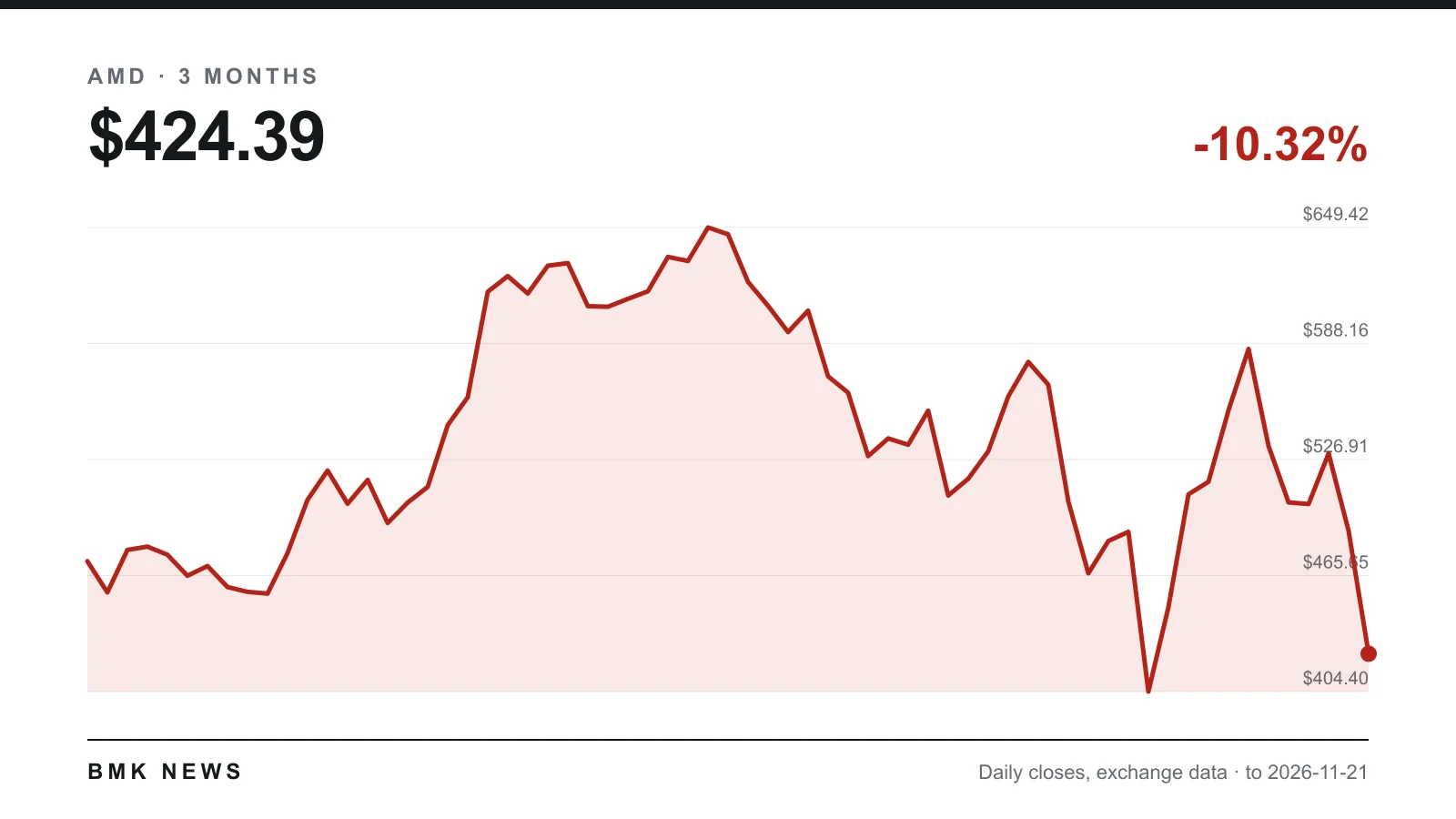
AMD shares lost 20.5% in the week to Friday 20 November, closing at $424.39 after a 13.25% fall on the last day, as short seller Hunterbrook reported that AMD firmware kept turning up at IEIT Systems, a Chinese server maker the US blacklisted in March 2025. AMD says the claims misrepresent its business, and even after the drop the stock is still up about 98% this year.
AMD's week in three numbers
- 20.5% fall in AMD shares over the five trading days to 20 November
- 22.4% share of AMD's 2025 revenue billed to China and Hong Kong, or $7.75bn
- 70.3m AMD shares traded on Friday, about 2.6 times the daily average
What Hunterbrook says it found at IEIT
A week earlier, AMD looked like the safe way to own the AI boom: its shares rose almost 45% in the five sessions to 12 November, the day Nvidia said Jensen Huang had resigned, according to Hunterbrook. Then, on Thursday 19 November, Hunterbrook Media published "AMD Has Its Own China Problem". Its affiliated fund, Hunterbrook Capital, is short AMD, meaning it profits if the shares fall.
Server makers build AMD's start-up code into the BIOS, the firmware that lets a server boot. Hunterbrook says IEIT Systems, an arm of China's Inspur Group, has put at least six newer versions of that code into updates for three server models since the US Commerce Department added it to the Entity List, Washington's trade blacklist, in March 2025. The latest was posted on 19 October.
The timing is the detail that sticks. In five IEIT builds, AMD's code turned up 25 to 61 days after AMD released it. One IEIT update posted in October 2025 already carried a fix for a flaw AMD did not disclose publicly until 24 February 2026, four months later.
Three sellers that are not blacklisted, Maginfra in China, Kaytus in Singapore and Aivres in Fremont, California, post firmware 99.94% identical to IEIT's. Kaytus's audited 2025 accounts name IEIT as its ultimate holding company, and Aivres was called Inspur Systems until May 2023, the report says. Neither IEIT nor the three sellers responded to Hunterbrook.
What the Hunterbrook report does not prove
Hunterbrook writes that its records "don't establish on their own a violation of export laws." It does not know how IEIT obtained AMD's code, or whether anyone held a licence to supply it. William Reinsch, a former Commerce undersecretary, told Hunterbrook not to rule out that AMD had one.
The report also questions a $67m licensing gain AMD booked in 2025, which it traces to two Chinese chip ventures with Hygon blacklisted in 2019. Zero Hedge pointed out that this is about 0.2% of AMD's $34.6bn of 2025 revenue, and that the Entity List restricts exports to listed companies, not payments from them.
How AMD responded to the short seller
AMD asked Hunterbrook for more time to answer, then did not get back in touch, the report says. Once it was out, an AMD spokesperson said in a statement emailed to Reuters: "The claims misrepresent AMD's business practices and relationships." The company added that it "complies with applicable US export control laws and regulations". Reuters said it could not independently verify the report.
The shares fell 8% on Thursday, Reuters reported. Friday was worse. AMD dropped $64.80 to $424.39 as 70.3m shares changed hands against an average of 26.9m, leaving a market value of about $696bn, well below the $1tn mark AMD passed in September.
Why China and Singapore matter for AMD shares
AMD billed $7.75bn, or 22.4% of its 2025 revenue, to customers in China and Hong Kong, Hunterbrook says, citing the annual report. Another $4.28bn, or 12.4%, was billed to Singapore. That does not by itself point to wrongdoing, the Motley Fool noted, but it leaves AMD exposed to tighter export rules.
Those rules are tightening now. The report landed the day new US licences for advanced chips took effect in Singapore, Malaysia, Indonesia, Thailand and Brazil. A separate rule that would extend blacklist curbs to firms at least 50% owned by listed companies is suspended until 10 January 2027; Zero Hedge noted it could catch Kaytus. AMD knows the cost: when Washington demanded licences for its China-specific MI308 AI chip in April 2025, it took about $800m in inventory and related charges.
Why the chip sell-off deepened AMD's fall
Short-seller reports often draw exaggerated reactions, though some expose real problems, the Motley Fool wrote. This one landed in a rout. The Philadelphia Semiconductor Index lost 17.1% in the week, its worst since September 2001, according to TheStreet Pro, and Nvidia dropped 14% on Friday alone after a Reuters report of a US probe into its accounting, capping a 23% week that extended its long run of weekly losses.
The S&P 500 fell 8.6% over the week and closed 11.6% below its 6 October record, deep enough to count as a stock market correction. Valuation made AMD a bigger target: it traded at 31.28 times expected earnings for the next 12 months, against 9.83 for Nvidia, on LSEG data cited by Reuters.
AMD now sits 35.6% below its 52-week high of $658.52, yet is still up 98.2% in 2026, on Trefis and Motley Fool data. Earlier this month it fell 17% in a day after record results, then rose 19% the following week. The next test is what AMD or Washington says about IEIT.
Why did AMD stock fall this week?
AMD fell 20.5% in the week to Friday 20 November after short seller Hunterbrook reported that AMD firmware kept reaching blacklisted Chinese server maker IEIT Systems, as chip stocks sold off.
What did AMD say about the Hunterbrook report?
AMD told Reuters on Thursday 19 November that the claims misrepresent its business practices and relationships, and that it complies with US export control laws.
How much of AMD's revenue comes from China?
China and Hong Kong accounted for $7.75bn, or 22.4%, of AMD's 2025 revenue, according to annual report figures cited by Hunterbrook.
Sources
- Hunterbrook: AMD Has Its Own China Problem
- Hunterbrook, The Bear Cave: Problems at AMD (AMD)
- The Standard (Reuters): AMD shares slide as report says China links could invite US scrutiny
- The Motley Fool: Why AMD Stock Was Plunging on Thursday
- Zero Hedge: Short Seller Comes For AMD's "China Problem", But Read The Fine Print
- TheStreet Pro: The S&P 500's Worst Week Since April 2025 Ends in a Correction
- Trefis: S&P 500 Movers, Winners GPN, GIS, MKC, Losers BE, NVDA, LITE