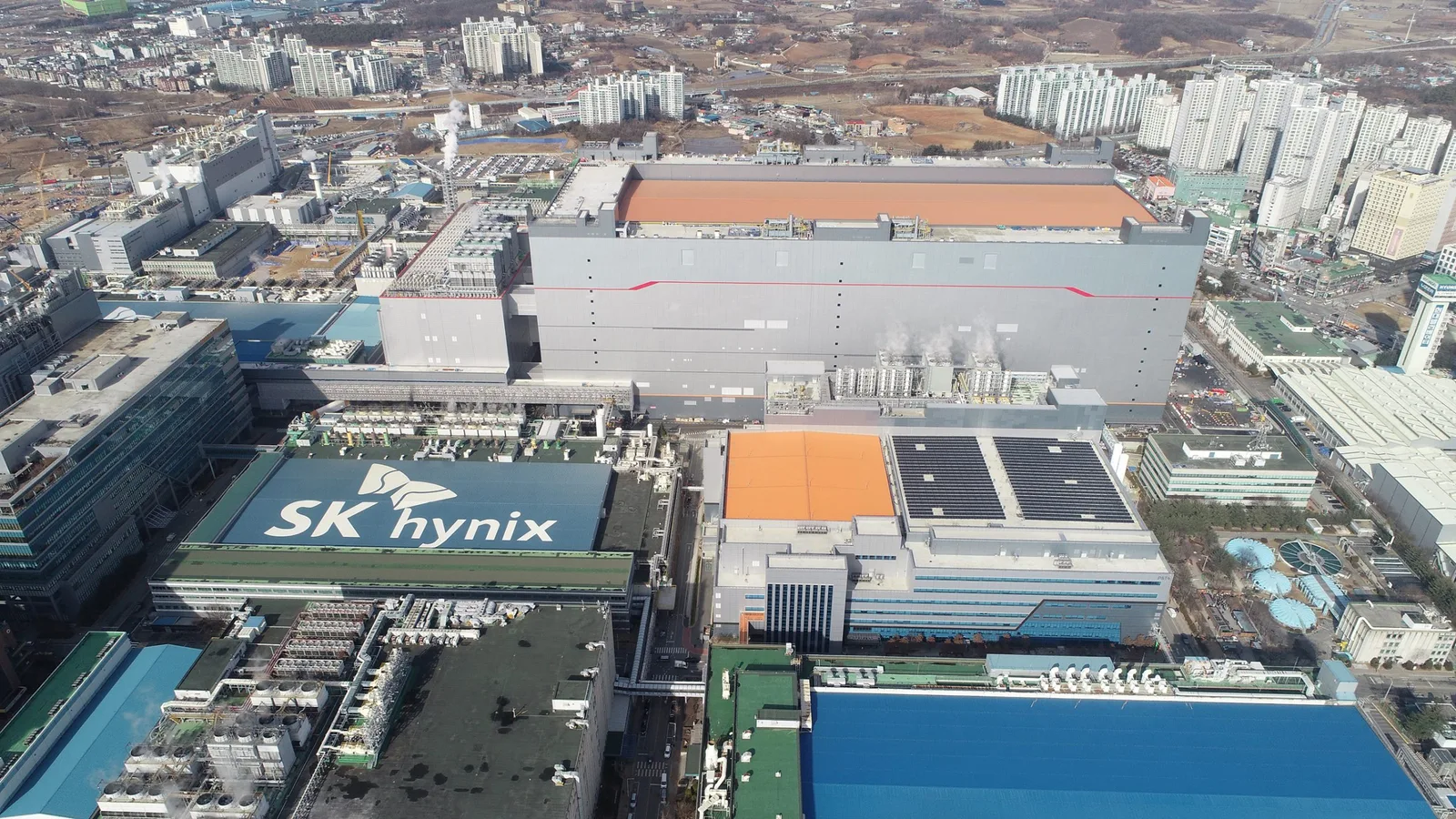
SK hynix, the South Korean memory maker and a key chip supplier to Nvidia, reported more than 100 trillion won of revenue in a single quarter for the first time. It paired the record with a plan to hand about 100 trillion won, roughly $75bn, back to shareholders this year through dividends and share buybacks. The company said demand for memory should exceed supply until 2030.
Third quarter 2026
- 104.6tn won revenue, up 328% from a year earlier
- 83.3tn won operating profit, an 80% margin
- 100tn won planned shareholder returns for 2026
A Quarter Without Precedent
Revenue for July to September was 104.6 trillion won, up 32% on the previous quarter and more than four times the 24.4 trillion won of a year earlier. Operating profit rose to 83.3 trillion won from 11.4 trillion won, a more than seven-fold increase. That came in well above the LSEG SmartEstimate of 76.7 trillion won.
The operating margin reached 80%, against 76% in the second quarter and 47% a year ago. Net profit was 39.8 trillion won, down 58% from 93.9 trillion won in the second quarter but more than three times the level of a year earlier.
The balance sheet has turned into a large cash pile. SK hynix held 114.5 trillion won of cash and equivalents at the end of September against 15.8 trillion won of borrowings, leaving net cash of 98.7 trillion won. The figures are preliminary and subject to audit.
How the 100 Trillion Won Is Split
The shareholder return plan for 2026 has two parts. At least 30 trillion won will be paid as cash dividends. At least 60 trillion won will go on buying back shares and cancelling them, including the 40 trillion won programme announced in August. The company said that earlier buyback was completed last week and the shares will be cancelled shortly. At the exchange rate cited by Reuters, the total is about $75.4bn.
For the third quarter, the board approved a dividend of 20,000 won a share. Half is a regular dividend reflecting higher earnings. The other half is a special dividend from gains on SK hynix's investment in the Japanese flash memory maker Kioxia. The company said it had decided to return most of this year's realised Kioxia gains to shareholders. The board also approved a new 20 trillion won buyback. Half will be cancelled and counts towards shareholder returns; the rest is earmarked for employee compensation and is excluded from the total.
The return policy
- At least 30tn won of cash dividends in 2026
- At least 60tn won of buybacks and cancellations, including August's 40tn won programme
- A Q3 dividend of 20,000 won a share, half of it a special payout from Kioxia gains
- A target of returning at least 50% of free cash flow
- Buybacks to continue every quarter
Going forward, SK hynix said it will return at least 50% of free cash flow. Regular dividends will be tied to operating results, large investment gains will be shared through special dividends, and buybacks will continue each quarter.
Long Contracts Cover Half of 2027 and 2028
The company's outlook explains why investors are paying close attention to its supply contracts. SK hynix said memory demand is expected to exceed supply through 2030, because leading-edge chip processes are technically difficult and new factories take a long time to build.
It has signed long-term agreements with 14 major customers, including leading cloud service providers. The contracts typically run for five years, and talks on extensions are under way. Together they cover more than half of the company's total production capacity for 2027 and 2028, with prices moving with market conditions within agreed ranges.
On products, shipments of HBM4, the latest generation of high-bandwidth memory used alongside AI processors, began in earnest in the third quarter. SK hynix expects HBM4 to overtake the previous HBM3E generation in both volume and revenue in the fourth quarter. Investment is set to rise significantly in 2027 as the first phase of its Yongin site enters full operation.
The company also said it had stopped reviewing a stock market listing for Solidigm, its storage business. Chief executive Kwak Noh-Jung said an IPO "would not be the best way to achieve the originally anticipated outcome".
Why the Shares Barely Moved
Despite the record and the size of the beat, SK hynix shares rose 2% in Seoul, in line with a 2.2% gain in the wider market, according to Reuters. Memory chip prices have been pushed up by demand for AI infrastructure, and the strength of that trend was already well known before the results.
The longer-term questions for shareholders are how durable today's margins are and how much of the cash will be reinvested. Memory has historically been a cyclical industry, in which shortages encourage new capacity that later pushes prices down. SK hynix's argument is that long contracts and the difficulty of making advanced chips make this cycle different. The capital return plan is, in part, a signal of how confident management is in that view.