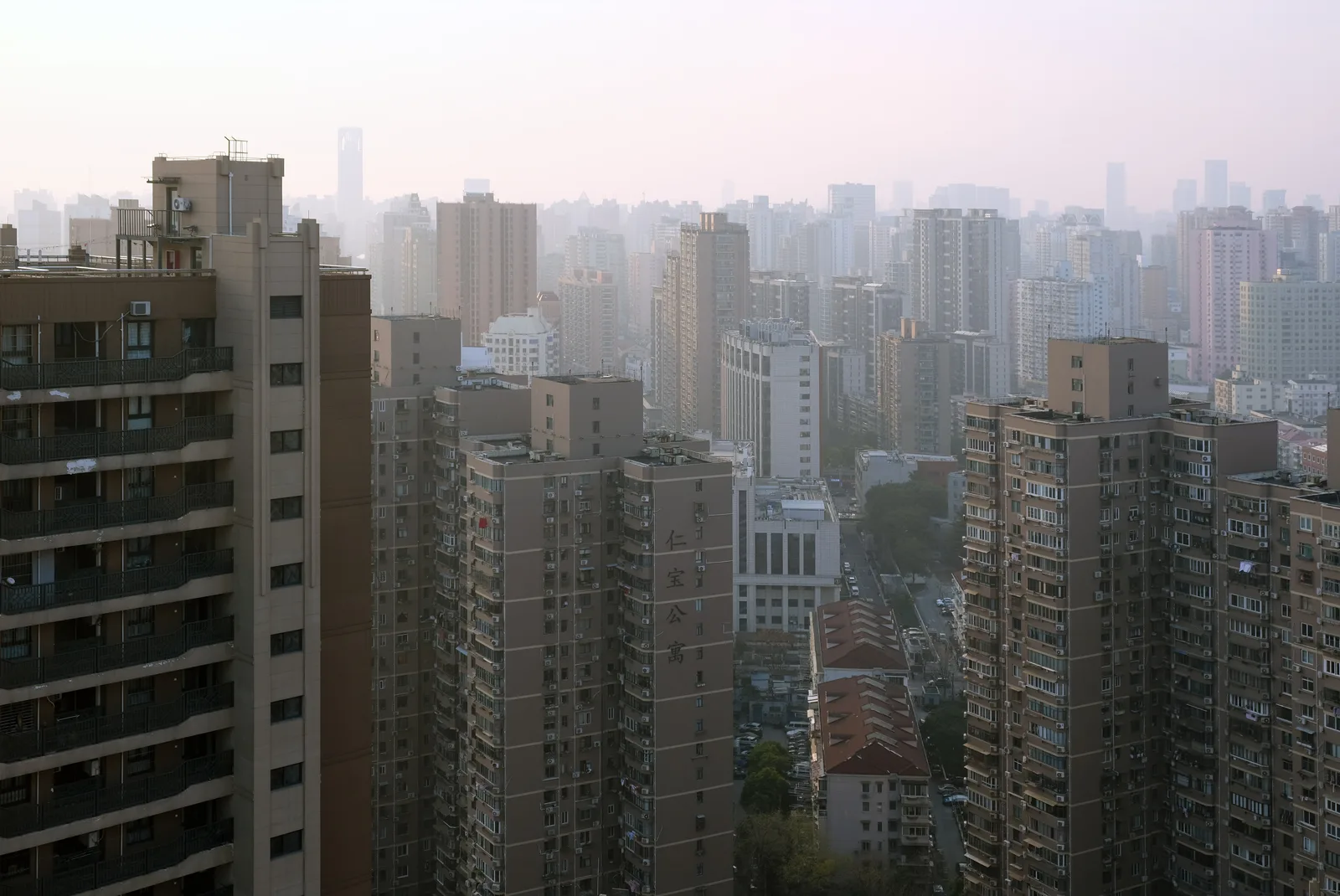
New-home prices in China fell from September in 49 of the 70 cities tracked by the National Bureau of Statistics, and resale prices fell in 58, according to October figures the bureau published on Monday 16 November. The falls from a year earlier are shrinking and the biggest cities are steadying, led by Shanghai. Across most of the country, though, homes are still getting cheaper, and shoppers are holding back: retail sales grew just 0.4%.
China's housing market in October
- 49 of 70 cities where new-home prices fell from September
- 58 of 70 cities where resale home prices fell from September
- 0.4% annual growth in China's retail sales of consumer goods
Most Chinese cities are still getting cheaper month by month
Each month the bureau publishes a price index for 70 cities, with the previous month set at 100. A reading below 100 means prices fell. In October, 49 cities came in below 100 for new homes, the same number as in September. Seven were flat and 14 rose, down from 17 risers a month earlier.
Resale homes, flats sold on by their previous owners, did worse. Prices fell on the month in 58 cities, held steady in five and rose in seven, against nine risers in September.
The monthly drops are small. ING, the Dutch bank, calculates that prices across the 70 cities fell 0.15% for new homes and 0.24% for resale homes, broadly the same pace as in September. The run is long, though: by ING's count, prices have now fallen for 41 months in a row.
The biggest cities are steadying, led by Shanghai
New-home prices in Beijing, Shanghai, Guangzhou and Shenzhen, the four "first-tier" cities, were 0.1% lower than in October 2025, a fall 0.4 percentage points smaller than in September, Xinhua reported, citing the bureau. New homes in second-tier cities were down 2% on the year and in third-tier cities 3.6%. By our count of the bureau's tables, the annual reading improved on September in 53 of the 70 cities for new homes and in 63 for resale homes.
Shanghai stands out. Its resale prices were 2.2% higher than a year earlier and rose 0.5% in October alone. ING said Shanghai's second-hand prices have now risen for nine straight months, the longest run since the property bust began.
| City | New homes m/m | New homes y/y | Resale m/m | Resale y/y |
|---|---|---|---|---|
| Beijing | -0.1% | -2.6% | 0.0% | -1.5% |
| Shanghai | +0.2% | +2.7% | +0.5% | +2.2% |
| Guangzhou | 0.0% | -0.4% | +0.2% | -1.8% |
| Shenzhen | +0.1% | -0.2% | +0.1% | -0.5% |
Elsewhere the slide goes on. New-home prices were below last year's level in 63 of the 70 cities, and resale prices in 68, with only Shanghai higher and Shenyang flat. In Luzhou, new homes cost 7.1% less than a year earlier and resale homes 8.2% less, the steepest annual falls in both tables.
Falling home values make for cautious shoppers
When a home, often the biggest thing a family owns, keeps losing value, the family tends to feel poorer even if its pay has not changed. Economists call this the wealth effect, and in China it is running in reverse.
The October figures fit that picture. Retail sales of consumer goods rose 0.4% from a year earlier to 4,646.3bn yuan, the bureau said. According to ING, that was down from 1.1% in September and below the 0.8% markets expected. Three categories fell by double digits, ING noted: gold and jewellery sales dropped 28.7% as gold prices fell, car sales 21.4%, and building and decoration materials 11.2%, which ING put down to weak renovation demand.
The car figure matters for any carmaker selling in China, European brands included.
BMW: share price, chart and news
Mercedes-Benz: share price, chart and news
Jobs held up better: urban unemployment fell to 5.1% in October from 5.2%, the bureau said. ING's Lynn Song, chief economist for Greater China, pointed to confidence instead. "Persistently weak consumer confidence remains the biggest obstacle to a sustained recovery in consumption," he wrote. He named two ways to restore it: stabilising asset prices and stronger wage growth.
Developers are still cutting back
Investment in real estate development fell 21.6% in the first ten months of 2026 from a year earlier, the bureau said. Sales of newly built commercial buildings fell 14.3% by value to 5,855.0bn yuan.
The resale market is busier, if cheaper: the floor space of second-hand homes sold through online transactions rose 11.4% in the same period, according to housing ministry figures published by the bureau.
What to watch next
- Whether the first-tier recovery spreads to more second-tier cities
- Whether more than 12 cities see resale prices hold or rise, already the highest share in five months, ING said
- How fast unsold housing stock falls, which ING said must happen before investment can rebound
ING called the steadying of first-tier prices an important first step toward restoring confidence. For now, homes are still getting cheaper in most of the other 66 cities, and retail sales are barely growing.
Questions and answers
Are house prices in China still falling?
Yes. In October 2026 new-home prices fell on the month in 49 of 70 cities and resale prices in 58, according to official data. Annual falls are shrinking, and Shanghai prices are above last year's level.
Why does the property slump hurt spending in China?
When home values keep falling, households feel poorer and tend to spend less. Retail sales grew just 0.4% in October, and ING's chief economist for Greater China called weak consumer confidence the biggest obstacle to a recovery in consumption.
Which Chinese cities saw home prices rise in October?
New-home prices rose on the month in 14 of 70 cities, including Shanghai, Shenzhen and Nanjing. Resale prices rose in seven, including Shanghai and Guangzhou.
Sources
- National Bureau of Statistics of China: Sales Prices of Commercial Residential Buildings in 70 Medium and Large-sized Cities in October 2026
- National Bureau of Statistics of China: National Economy was Generally Stable with Innovation-Led and High-Quality Development in October
- National Bureau of Statistics of China: Sales Prices of Commercial Residential Buildings in 70 Medium and Large-sized Cities in September 2026
- Xinhua: Major Chinese cities continue to see narrowed home price declines in October
- ING THINK: China's October domestic activity data disappoints across the board