Inditex, the owner of Zara, reported a record first-half net profit of €2.98 billion on Wednesday, up 6.8 percent, and said autumn sales had started strongly. Its shares still fell about 4 percent in early trading in Madrid, as investors had expected even more.
Net sales for the six months from 1 February to 31 July rose 7.6 percent to €19.76 billion, from €18.36 billion a year earlier. At constant exchange rates, growth was 9.2 percent, which shows how much currency moves are eating into reported numbers. Net profit rose from €2.79 billion.
The Spanish group, the world's largest fashion retailer by sales, is one of the closest things European investors have to a real-time reading of consumer spending across the continent. More than half of its sales come from Europe outside Spain.
Inditex, first half 2026
- €19.76bn net sales, up 7.6%
- €2.98bn net profit, a record, up 6.8%
- 9% sales growth, 1 August to 7 September
A faster second quarter and a strong autumn start
The half was a story of acceleration. Sales growth picked up from 5.8 percent in the first quarter to about 9.1 percent in the second, according to figures compiled by FashionUnited. That compares with growth of just 1.6 percent in the first half of 2025 and 3.2 percent across the whole of that financial year.
The company also said sales in stores and online rose 9 percent at constant exchange rates between 1 August and 7 September, compared with the same weeks a year earlier. The start of the autumn and winter season is closely watched because it sets the tone for the most important trading months of the year. Inditex expects currencies to reduce reported sales by about 1 percent over the full financial year.
Operating performance kept pace with sales. EBITDA rose 7.8 percent to €5.5 billion. Net profit grew a little more slowly than sales, so the net margin eased to about 15.1 percent from 15.2 percent a year earlier, a marginal change, but one that investors noticed.
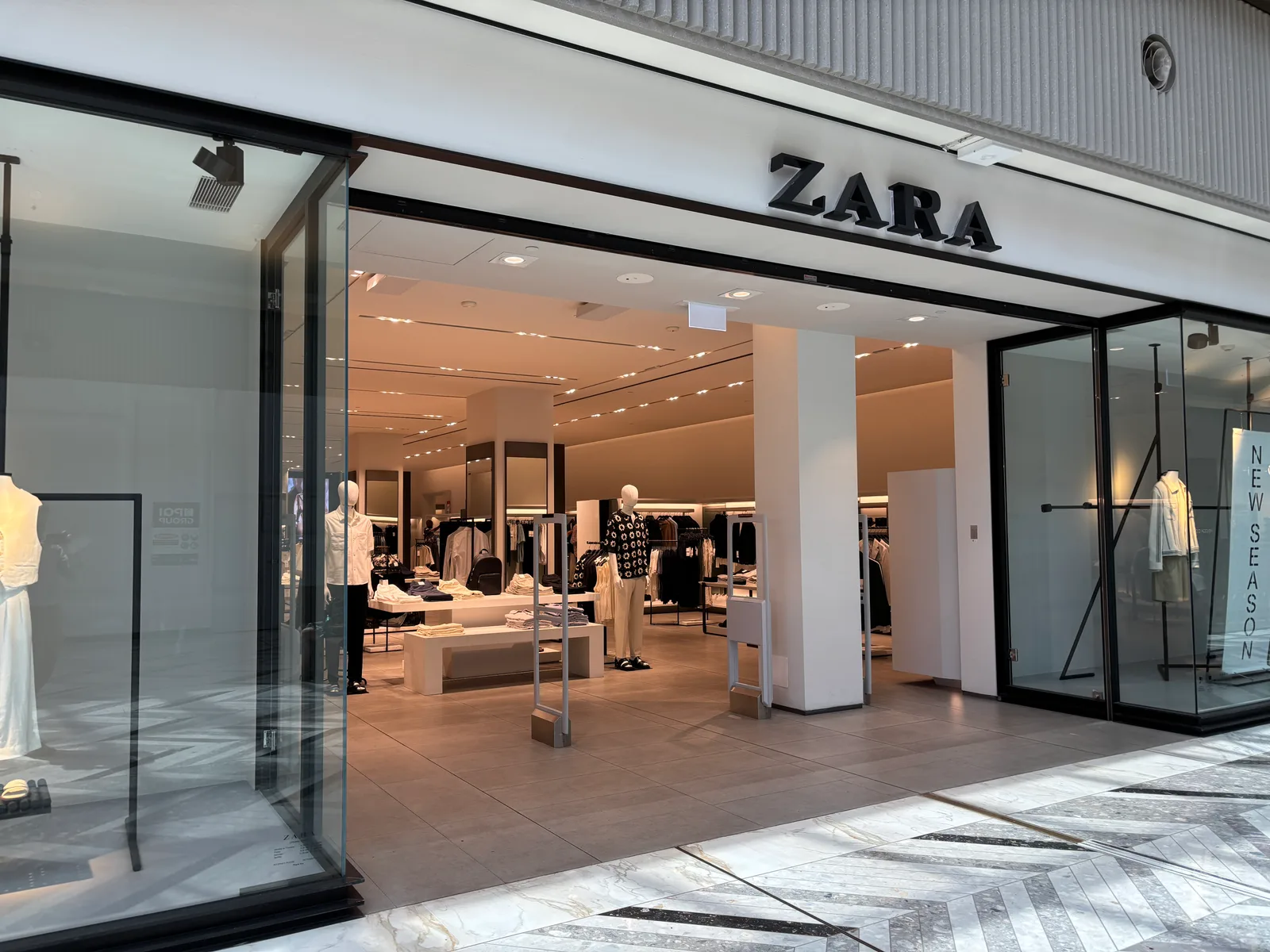
Zara grows slowest as smaller brands race ahead
The flagship brand, which in Inditex's reporting includes Zara Home and Lefties, still generates about seven in every ten euros of sales. But it was the slowest-growing part of the group.
| Brand | H1 sales | Growth |
|---|---|---|
| Zara (incl. Zara Home, Lefties) | €13.78bn | +4.8% |
| Bershka | €1.68bn | +16.7% |
| Stradivarius | €1.57bn | +18.5% |
| Pull&Bear | €1.26bn | +8.9% |
| Massimo Dutti | €988m | +10.4% |
| Oysho | €472m | +21.3% |
The younger-skewing brands Bershka and Stradivarius, and the sportswear and lingerie label Oysho, all grew at double-digit rates. That broadens the group's growth, but because they are much smaller, they cannot fully offset slower growth at Zara on their own.
By region, Europe excluding Spain accounted for 51.5 percent of sales, up 0.8 percentage points. The Americas made up 17.9 percent and Spain 15.6 percent. Asia and the rest of the world fell by a point to 15 percent, which GlobalData linked to the restructuring of the store portfolio there. Sales grew in every region at constant exchange rates.
Why the shares fell on a record result
The early sell-off says more about expectations than about the numbers. Inditex shares had been priced for a strong half, and a profit that grew slightly less than sales, alongside slower growth at Zara, gave investors a reason to take money off the table. Sharon Iles, senior apparel analyst at GlobalData, said the fall suggested investors had "priced in an even stronger set of results."
The group continued to invest in its physical network, with new Zara flagships in Los Cabos in Mexico, on London's Bond Street, in Seoul's Gangnam district and in Ostend in Belgium. It has also finished rolling out RFID-enabled tags across its entire store network, which lets it track individual garments from distribution centre to shop floor.
Chief executive Óscar García Maceiras pointed to ambition, flexibility and innovation as the qualities behind the group's long-term growth.
What the results say about Europe's shoppers
For the wider market, the message is mixed but reassuring. A 9 percent rise in early autumn sales suggests that shoppers in Europe, Inditex's largest market, are still spending on clothes even as higher fuel prices weigh on household budgets.
The next checkpoint is the nine-month trading update, which will show whether the early autumn momentum lasted through the rest of the season and whether Zara's growth picks up again.