Money is pouring into robots, but most of it is going into private companies that ordinary investors cannot buy. What is left on the stock market is usually a small slice of a bigger business, a richly priced story stock or a fund trading far above the value of what it owns.
The access gap in three numbers
- $18.8bn raised by robotics start-ups by mid-June 2026
- 165x Tesla's forward earnings multiple
- 2.4x RoboStrategy's share price against its asset value
Where the money goes, and why it stays private
Robotics start-ups raised $18.8 billion (€16.6 billion) in 2026 by mid-June, according to Crunchbase data, already more than in the whole of 2025, which was itself a record year. Almost all of that capital went to companies that are not listed and may not be for years.
That reflects a broader change in how technology companies grow. Jay Ritter, the University of Florida professor known for his research on initial public offerings, found that the median US tech company that listed in 2025 was 12 years old, compared with four years in 1999. Companies now stay private far longer, so much of the steep early growth that once went to stock market investors now goes to venture funds and their backers.
Regulators have noticed. Paul Atkins, chair of the US Securities and Exchange Commission, said in March that exposure to private companies should not be reserved for people who pass a wealth test or are judged sophisticated enough. The rules have not yet changed enough to put names such as Figure AI or Apptronik in a normal brokerage account.
The market for the most talked-about machines is also still small. The International Federation of Robotics counted about 7,000 humanoid robots sold worldwide last year for industrial and professional use, against 603,000 industrial robots installed.
Tesla: share price, chart and news
The listed giants: real robots, diluted exposure
The obvious public route is an established company that makes robots or automation equipment. The question is how much of the business robots actually represent.
| Company | Where it trades | Robotics exposure |
|---|---|---|
| Fanuc | Tokyo | Robots were 44% of sales in the year to March |
| ABB | Zurich, Stockholm | Robots were 7% to 10% of revenue over two years; unit being sold to SoftBank for $5.4bn |
| Tesla | Nasdaq | No Optimus sales yet; cars made $20.5bn of $28.2bn Q2 revenue |
| Siemens | Frankfurt | Supplies factory software and controllers, not robots |
| KUKA | No longer listed | Left the market in 2022 after Midea took full control |
Japan's Fanuc is the closest thing to a large listed pure play, with robots making up 44 percent of sales in its last financial year. The Swiss-Swedish group ABB earned only 7 to 10 percent of its revenue from robots over the past two years, and it agreed to sell the unit to SoftBank for $5.4 billion (€4.7 billion) rather than list it separately, as it had originally planned. Germany's KUKA, once a favourite of automation investors, left the stock market in 2022 after China's Midea took full control. Siemens, often grouped with robotics stocks, makes the software and controllers that run automated factories rather than the robots themselves.
For investors, that means buying ABB or Siemens for robot exposure is mostly a bet on electrification, automation and industrial software, with robots as a minor part of the result.
Tesla and the price of a promise
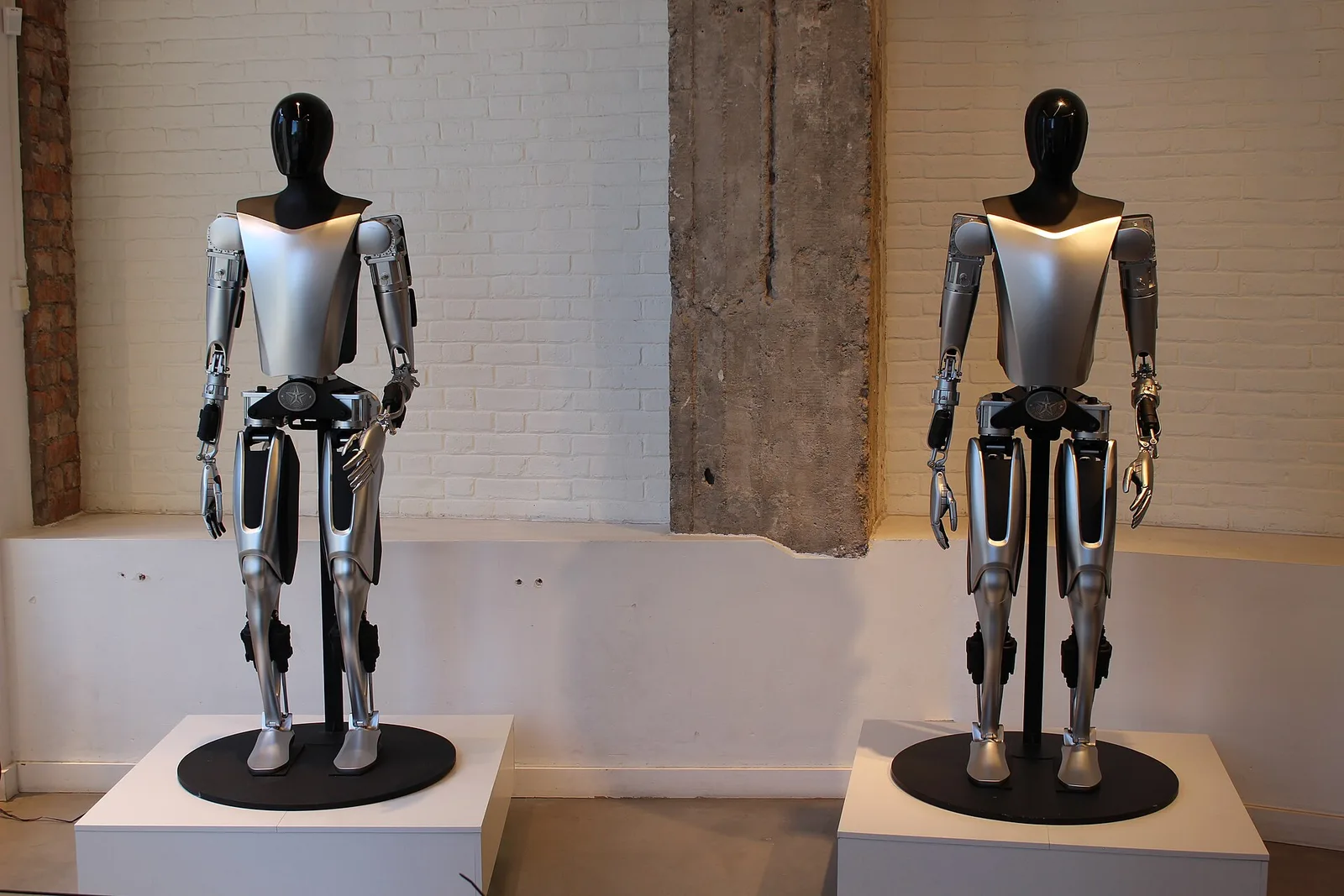
Tesla is the stock many private investors treat as a humanoid robot proxy, and its chief executive encourages that view. Elon Musk said last year that about 80 percent of Tesla's value will come from Optimus, its humanoid robot. Tesla has started building Optimus at its plant in Fremont, California, and Musk told the World Economic Forum in Davos in January that humanoid robots would be sold to the public by the end of 2027. He has also warned that production would be very slow at first.
Today's numbers are a carmaker's numbers. The automotive business generated $20.5 billion of Tesla's $28.2 billion revenue in the second quarter, almost three quarters of the total, and Optimus has yet to record a sale. Yet the shares trade at 165 times forward earnings. Dan Coatsworth, head of markets at the UK investment platform AJ Bell, points out that European carmakers typically trade on less than 10 times.
The gap between those two multiples is, in effect, a price paid today for robot revenue that does not yet exist. If Optimus arrives on time and at scale, that premium may look reasonable. If it does not, the shares have a long way to fall back towards a car-industry valuation.
Listed funds of private stakes: paying a premium for scarcity
A newer route is a listed fund that owns stakes in private robotics companies. RoboStrategy, which trades on Nasdaq under the ticker BOT, began trading in May. It is run by Andrew Kang, co-founder of the crypto investment firm Mechanism Capital, and in June its three largest holdings, Figure AI, Dyna Robotics and Apptronik, each made up close to 20 percent of net assets.
The catch is the price. On a recent Friday its shares opened at $27.34, about 2.4 times the fund's net asset value of $11.35 per share at the end of August. The shares had peaked at $59 in May. Buyers in early July paid nearly four times the value of the underlying holdings and have since lost about a quarter of their money, even though net asset value per share rose 27 percent over roughly the same period.
Costs and valuation methods add to the risk. The fund charges a 2.5 percent annual management fee, with total yearly expenses of almost 4 percent, and its private holdings are valued on estimates rather than market prices. Its own documents describe an investment as speculative and highly risky. Coatsworth calls it "a scarcity premium which can happen with a hot investment area."
There is an uncomfortable precedent. Destiny Tech100, which holds stakes in private companies such as SpaceX and OpenAI, traded at roughly a 2,000 percent premium to its asset value within two weeks of listing on the New York Stock Exchange in 2024. It closed at $99.79 on 8 April 2024 and fell to $29 by 12 April, a drop of about 71 percent in four days. When a premium to asset value collapses, investors can lose heavily even if the companies inside the fund do well.
ETFs and Chinese listings: the remaining doors
Thematic exchange-traded funds offer a broader basket. Roundhill's humanoid robotics ETF counted Tesla, the Chinese robot maker UBTech and the carmaker Hyundai among its biggest holdings at the end of June, which shows how much of a robotics fund can end up in companies whose main business is something else. Coatsworth notes that several robotics ETFs trade close to their net asset value. That removes the premium risk that affects closed-end funds, though not the valuation risk of the shares inside them.
China has some of the most visible pure plays, but access is limited. The robot maker Unitree rose 460 percent on its debut on Shanghai's STAR Market in August. Foreign investors generally need a special licence to buy newly listed shares there, which keeps most European retail investors out.
What each route really offers
- Large listed groups such as Fanuc and ABB give real robot revenue, often as a small share of the business
- Tesla's valuation already prices in humanoid robot sales that have not started
- Listed funds of private stakes can trade at multiples of their asset value, with estimated valuations and high fees
- Robotics ETFs track asset value more closely but hold many companies that mainly do other things
- The purest Chinese listings are hard for foreign private investors to reach