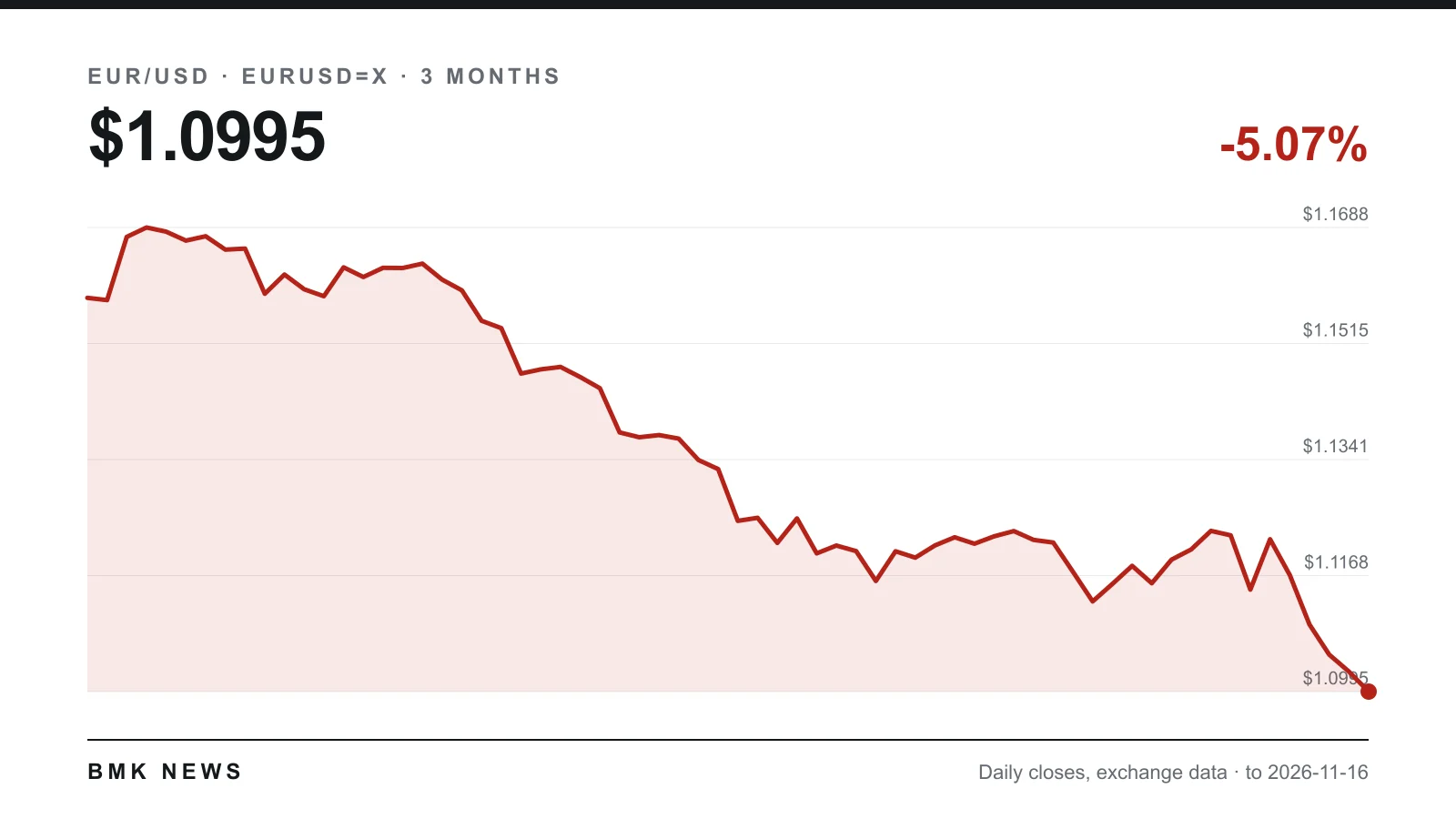
The euro slipped below $1.10 on Monday 16 November for the first time since April 2025, touching $1.0998, according to Bloomberg. Traders expect the US Federal Reserve to raise interest rates further than the European Central Bank, and that pulls money towards the dollar. For euro area households, anything priced in dollars, from crude oil to a New York hotel room, now costs more, while the US shares they own are worth more.
The euro on Monday 16 November
- $1.0998 Monday's low, the euro's weakest level in 19 months
- 8.7% how much dearer a dollar is in euros than at the euro's January peak
- $1.1014 the ECB's official reference rate for the day
The euro has lost 8% against the dollar since January
On 28 January the ECB's reference rate, the official exchange rate it publishes each afternoon, put one euro at $1.1974. By Monday it was $1.1014, a fall of 8% and the fourth daily drop in a row. That is the lowest reading since 8 April 2025.
Put the other way, a dollar that cost about 84 cents in January now costs close to 91 cents. The dollar index, which tracks the US currency against a basket of major peers, rose 0.2% to 103.58 on Monday, its highest since 2 April 2025, CNBC reported.

Bets on a Fed hike are pulling money into the dollar
The driver is the gap between what investors expect from the two central banks. Higher interest rates make a currency more attractive to hold, because cash and bonds in it earn more.
The Fed raised its target range by a quarter of a percentage point on 17 September, to 3.75% to 4%, and stronger than expected US inflation figures for October have hardened bets on another rise. Fed funds futures implied a 95.7% chance of a quarter-point increase at the meeting that ends on 9 December, according to CME's FedWatch tool, as cited by CNBC.
The ECB lifted its deposit rate, the rate it pays banks on overnight money, to 2.50% from 16 September and left it there in October. Swap markets, where traders lock in future interest rates, price roughly 0.9 percentage points of US tightening over the next year against about 0.7 points from the ECB, Bloomberg reported.
August Hyldgaard, an analyst at Danske Bank, put the move down mainly to solid US economic data and an increasingly hawkish Fed, according to Bloomberg. Hawkish here means inclined to raise rates. Boston Fed President Susan Collins has said the Fed may need to raise rates beyond recent forecasts, according to a market report from the broker TMGM.
What a weaker euro costs at home
Plenty of what households buy is priced in dollars somewhere along the way: crude oil, many raw materials, US holidays, orders from American retailers. When the euro buys fewer dollars, the same dollar price becomes a bigger euro bill.
| Paid in dollars | 17 Nov 2025 ($1.1593) | 28 Jan 2026 ($1.1974) | 16 Nov 2026 ($1.1014) |
|---|---|---|---|
| $50 online order | €43.13 | €41.76 | €45.40 |
| $1,000 hotel bill | €862.59 | €835.14 | €907.94 |
| $2,500 US trip budget | €2,156.47 | €2,087.86 | €2,269.84 |
| $92.14 barrel of Brent crude | €79.48 | €76.95 | €83.66 |
ECB reference rates. The Brent price is the latest US Energy Information Administration (EIA) spot price, for Wednesday 11 November.
Fuel is the exception. Brent, the European oil benchmark, has fallen hard in dollars, from $128.12 a barrel on 26 October to $92.14 on 11 November, according to the EIA. Converted at each day's ECB rate, that is a drop from about €114.52 to €82.81, or roughly 28% in euros. The weaker currency has taken only a small bite out of that relief, and crude is just one part of a pump price, alongside taxes and refining.
US shares gain in euro terms
The arithmetic works in reverse for owners of US shares or funds. Their prices are set in dollars, so a stronger dollar makes each holding worth more in euros. A US share that had not moved in dollars since 28 January would now be worth about 8.7% more to a euro-based investor, before fees and taxes.
That cushion can vanish if the euro recovers. Funds that hedge currency risk, using contracts to cancel out exchange-rate moves, pass on little of it either way.
The weaker euro at home
- A $1,000 US hotel bill costs about €908, against €835 in late January.
- Oil's fall has so far outweighed the currency's drag on fuel.
- Unhedged US shares are worth more in euros.
What could move the euro next
US retail sales and the euro area's ZEW survey of investor sentiment are due on Tuesday 17 November, followed by final October inflation for the euro area on Wednesday 18 November, with a run of Fed speakers through the week.
Benjamin Ford of the research firm Macro Hive sees $1.08 as achievable by the end of the year, CNBC reported. Recent ECB comments point towards a rate rise in December, according to the TMGM report, which could narrow the gap between the two central banks.
Questions and answers
Why is the euro falling against the dollar?
Markets expect the US Federal Reserve to raise interest rates more than the European Central Bank over the next year. Higher US rates make the dollar more attractive to hold, so the euro weakens.
Does a weaker euro make petrol more expensive?
Oil is priced in dollars, so a weaker euro raises the euro cost of crude. But Brent has fallen by more than a quarter in euro terms since late October, which so far outweighs the currency move.
How much more does a US holiday cost with the euro at $1.10?
At Monday's ECB rate of $1.1014, a $2,500 trip budget costs about €2,270, against about €2,088 in late January: roughly €182 more.
Sources
- Bloomberg via Yahoo Finance: Euro Falls Below $1.10 For First Time Since April 2025
- CNBC: Dollar hits highest since April 2025 as Fed rate bets lend support
- TMGM: Euro falls to new 19-month low as hawkish Fed outlook drives selling
- European Central Bank: Euro reference exchange rates, US dollar
- European Central Bank: Key ECB interest rates
- Federal Reserve: Open market operations and target rate changes
- US Energy Information Administration: Europe Brent spot price FOB, daily