NGEx Minerals has published the first metallurgical test results from Lunahuasi, its high-grade copper-gold-silver discovery in Argentina. Simple flotation recovered 92% to 94% of the copper, and a follow-up treatment step removed most of the arsenic that comes with the deposit's main copper mineral. The work is early and covered only one style of mineralisation.
What the tests found
The Toronto-listed explorer released the results on 15 September, the day of its investor day. Testing used three composites, one for each of the main vein zones drilled so far: Mars, Saturn and Jupiter. They were built from more than 3,200 kg of coarse reject material taken from 45 intersections in 19 diamond drill holes, about 1,229 metres of core.
The composites were high grade. Mars averaged 4.16% copper and 5.38 g/t gold, Saturn 3.85% copper and 3.50 g/t gold, and Jupiter 2.51% copper and 1.78 g/t gold, with silver of 37 to 61 g/t.
Base Metallurgical Laboratories in Kamloops, British Columbia, ran the flotation tests. A simple sequence using rougher stages only, with no cleaning stages, produced a copper concentrate and then a separate pyrite concentrate. The finest grind tested gave the best and most selective recoveries.
| Zone | Copper recovery | Gold recovery | Silver recovery | Copper grade of concentrate |
|---|---|---|---|---|
| Mars | 94.2% | 87.1% | 88.3% | 27.8% |
| Saturn | 92.0% | 79.6% | 84.0% | 23.8% |
| Jupiter | 93.6% | 61.1% | 80.2% | 17.6% |
Where there was more pyrite relative to enargite, more of the gold and silver went to the pyrite concentrate, which explains the lower gold recovery at Jupiter. Combining the two concentrates into one bulk product recovered 98.3% of the copper, 95.6% of the gold and 97.3% of the silver, at a lower copper grade of 16.8% after treatment.
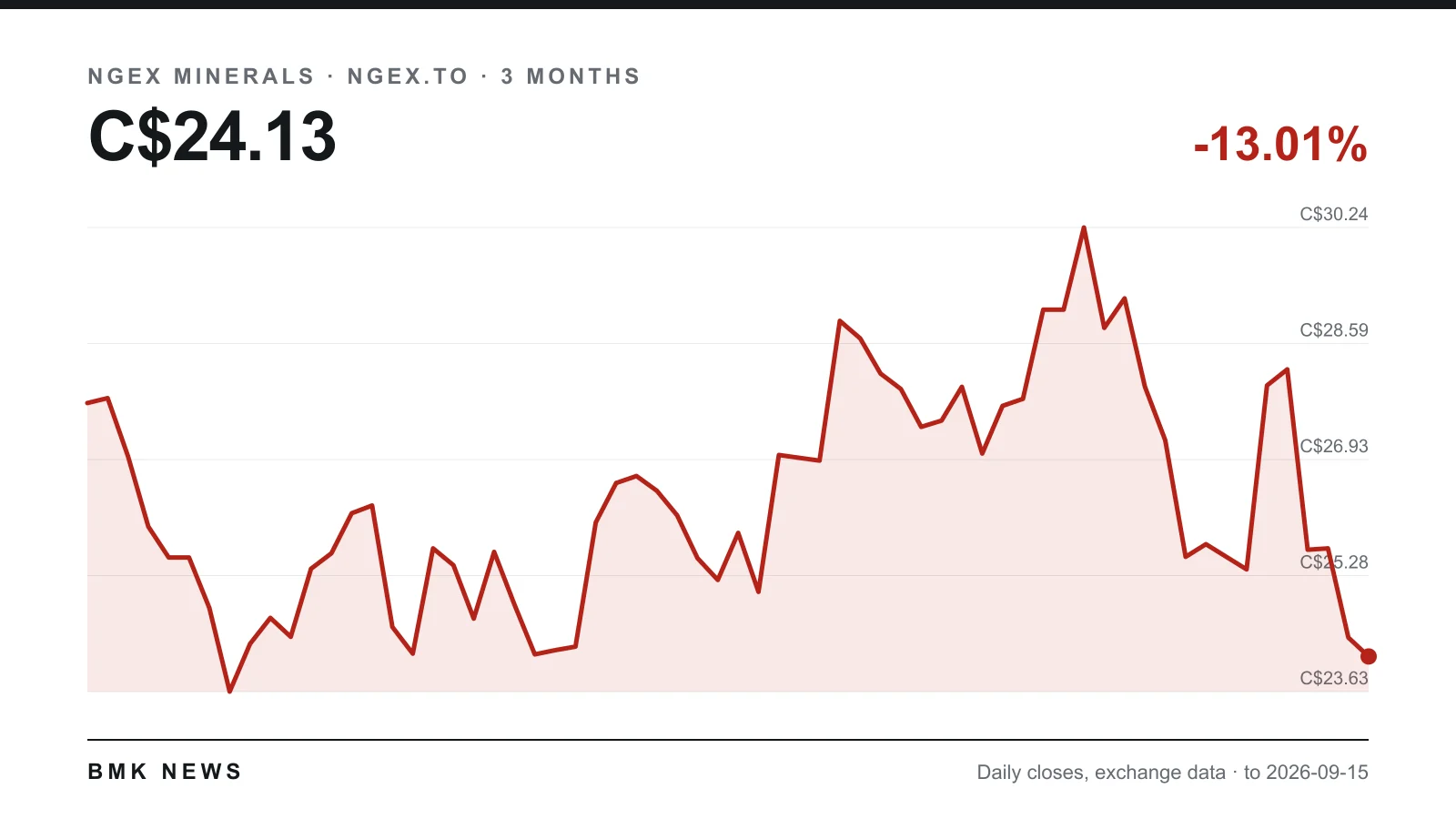
NGEx Minerals: share price, chart and news
The arsenic question
Lunahuasi's main copper mineral is enargite, a copper-arsenic sulphide. The raw copper concentrates from all three zones carried 7.6% to 11.1% arsenic, above the typical limits at which smelters start charging penalties. Dealing with that arsenic is one of the main technical questions for the project.
NGEx tested four ways to treat it, at Dundee Sustainable Technologies in Quebec and SGS Canada in Ontario: pressure oxidation; the Albion process, a Glencore technology that works at ambient pressure and temperature; caustic leaching; and Dundee's own GlassLock process, in which pyrolysis is followed by locking the arsenic into slag. All four stabilised most of the arsenic under the standard TCLP leach test.
GlassLock gave the best result. It removed more than 95% of the arsenic and cut concentrate mass by 25% to 30%, with no reported losses of copper, gold or silver. After treatment the concentrates graded 23.4% to 39.4% copper and 9.5 to 43.7 g/t gold, with arsenic down to 0.2% to 0.3%.
Lunahuasi metallurgy at a glance
- 92.0-94.2% copper recovery to the copper concentrate
- >95% of arsenic removed by the GlassLock process
- 39.4% copper in the best treated concentrate, from Mars
What the company said
Chief executive Wojtek Wodzicki called the results "highly encouraging and an important first step". NGEx said the other treatment routes also performed well, including options that could produce copper cathode and doré on site.
Comminution tests rated the material as moderately hard, with Bond ball mill work indices of 13.5 to 16.2 kWh per tonne. Bob Carmichael, the company's vice-president of exploration, is the qualified person who approved the technical disclosure.
Limits and next steps
What the tests do not yet show
- Only high-sulphidation vein material was tested. High-grade gold veins and porphyry material, which NGEx does not expect to contain arsenic minerals, will be tested later.
- The composites came from high-grade intervals; a wider range of grades and mineral ratios still needs testing.
- Lunahuasi has no mineral resource estimate and no economic study yet.
- The cost of the extra arsenic treatment step has not been published.
NGEx plans to optimise grind size and reagents, test more concentrate cleaning options and run trade-off studies on the treatment routes. It will also look at blending the precious-metal-bearing pyrite concentrate into the copper concentrate to raise recoveries, and carry out further variability, scale-up and comminution work.
Lunahuasi is wholly owned by NGEx and lies in San Juan Province, Argentina. The company also holds about 69% of the Los Helados copper-gold project in Chile, about 9 km away, under a joint exploration agreement with Lundin Mining. As an exploration company, NGEx pays for its drilling from cash and investments, and Argentine permitting, funding needs and the eventual size of the deposit remain the main uncertainties for shareholders.