Palo Alto Networks shares rose more than 8% in late trading on Wednesday 18 November after the cybersecurity company beat forecasts, "materially" raised its full-year outlook and agreed to buy AI start-up Applied Compute in an all-stock deal valued at $4.5bn. Revenue grew 39% to $3.44bn in the quarter to 31 October, though operating profit under standard accounting rules shrank to $96m.
Palo Alto Networks, quarter to 31 October 2026
- $3.44bn Revenue, up 39% on a year earlier
- $9.73bn Next-generation security ARR, up 66%
- $4.5bn All-stock price agreed for Applied Compute
Palo Alto Networks beat forecasts and raised its revenue outlook
The results landed at 4:05pm New York time, after the close. Analysts had expected earnings of 97 cents a share on revenue of $3.31bn, SiliconANGLE reported. Palo Alto delivered adjusted earnings per share of $1.05, up from 93 cents a year earlier, on revenue of $3.44bn.
The figure the company leans on hardest is next-generation security annual recurring revenue, or ARR: the yearly value of its active contracts for newer products, leaving out hardware and older add-on services. It jumped 66% to $9.73bn. Chairman and chief executive Nikesh Arora called it a "record Q1" with "one of our highest NGS ARR beats ever".
"Given the current threat environment and demand we see ahead of us, we are materially raising our full year guidance," said chief financial officer Dipak Golechha. Revenue for the year to July 2027 is now expected at $14.52bn to $14.57bn, up from the $14.10bn to $14.20bn guided in September, according to SiliconANGLE. The new range for adjusted earnings, $4.26 to $4.30 a share, sits above the $4.18 that analysts polled by FactSet expected.
| Fiscal 2027 outlook | New range |
|---|---|
| Revenue | $14.52bn to $14.57bn |
| Next-generation security ARR | $11.475bn to $11.525bn |
| Adjusted earnings per share | $4.26 to $4.30 |
| Adjusted free cash flow margin | 38% |
Why Palo Alto Networks is buying Applied Compute for $4.5bn
Applied Compute sells a platform for post-training and inference of open-weight AI models. In plain words, it helps companies take a model whose trained settings are published openly, tune it on their own data and run it at scale. Palo Alto argues that a large share of companies will run such models, and that no large provider is yet delivering them securely.
"Every enterprise is going to run a mix of open and closed models, and every one of those models needs to be secured," Arora said.
Applied Compute was founded in 2025 by former OpenAI researchers Yash Patil, Rhythm Garg and Linden Li, according to SiliconANGLE. Earlier in November it raised $350m at a $3.25bn valuation in a round led by Elad Gil, with Nvidia among the investors: the same chipmaker whose $130bn forecast lifted chip stocks this week. At the time, it said annualised recurring revenue had passed $100m, and its customers include Microsoft and DoorDash. Palo Alto's price is about 38% above that valuation from only weeks ago.
Paying in shares means existing Palo Alto shareholders will own a smaller slice of the enlarged company. It also means no new borrowing, days after the Fed and ECB warned that the AI boom is turning to debt.
Patil will become co-chief AI officer once the deal closes, expected in Palo Alto's fiscal third quarter, February to April 2027, subject to regulatory clearance. The announcement came on the evening Anthropic was due to price its Nasdaq listing, another test of what investors will pay for AI.
Why Palo Alto's operating profit fell to $96m
Operating income under GAAP, the standard US accounting rules, fell to $96m from $309m a year earlier, a margin of under 3%. On the company's adjusted measure, which strips out share-based pay and deal costs, it rose to $1.06bn from $746m.
Most of the $963m gap is share-based pay, which climbed to $622m from $387m. Nearly all the rest is the bill for buying growth. Amortisation of acquired intangibles, the gradual write-off of technology and customer relationships bought in earlier deals, rose to $282m from $39m, and acquisition-related costs reached $55m, against $5m.
Pre-tax profit was just $25m. Net income still rose to $482m from $334m, thanks to a $457m tax benefit; the release says the quarter included a one-time adjustment from a change in its tax position on a historical transaction.
The balance sheet has shifted too. Palo Alto now lists $1.93bn of convertible senior notes, bonds that holders can swap into shares, as a short-term liability. At the end of July the line stood at $1.77bn among long-term liabilities, and the release's footnotes say these notes came with the CyberArk takeover. The company held $2.59bn of cash and $461m of short-term investments, and generated $1.93bn of operating cash flow in the quarter.
What Palo Alto Networks expects for its next quarter
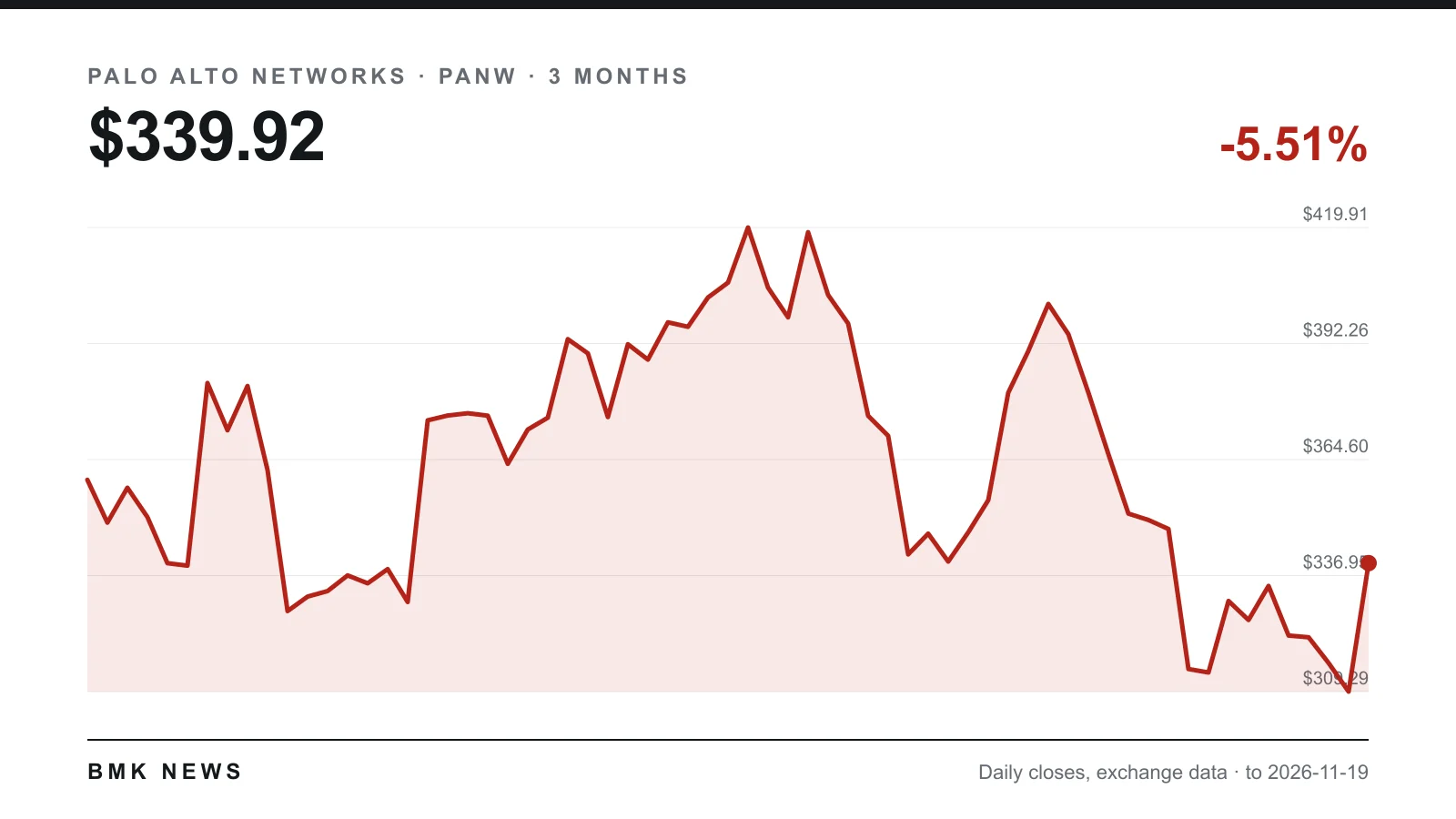
The late jump came on top of a gain of nearly 10% in the regular session, SiliconANGLE said. For the quarter to the end of January, Palo Alto expects revenue of $3.53bn to $3.55bn, growth of 36% to 37%, and adjusted earnings per share of $1.01 to $1.03.
The bigger test is the deal. Palo Alto is betting that companies will want to tune and run their own open models, with a security company keeping them safe. A start-up with more than $100m of recurring revenue now has to grow into a $4.5bn price tag inside a company that sells more than $3bn a quarter.
Why did Palo Alto Networks stock rise after hours?
Palo Alto Networks shares rose more than 8% in late trading on Wednesday 18 November 2026 after first-quarter revenue grew 39% to $3.44bn, beating forecasts, and the company raised its full-year revenue outlook to as much as $14.57bn.
How much is Palo Alto paying for Applied Compute?
Palo Alto Networks agreed on 18 November 2026 to buy Applied Compute in an all-stock deal valued at $4.5bn, subject to adjustments. It expects the deal to close in its fiscal third quarter of 2027, once regulators clear it.
What does Applied Compute do?
Applied Compute runs a platform that helps companies tune open-weight AI models on their own data and run them at scale. Former OpenAI researchers founded it in 2025, according to SiliconANGLE.