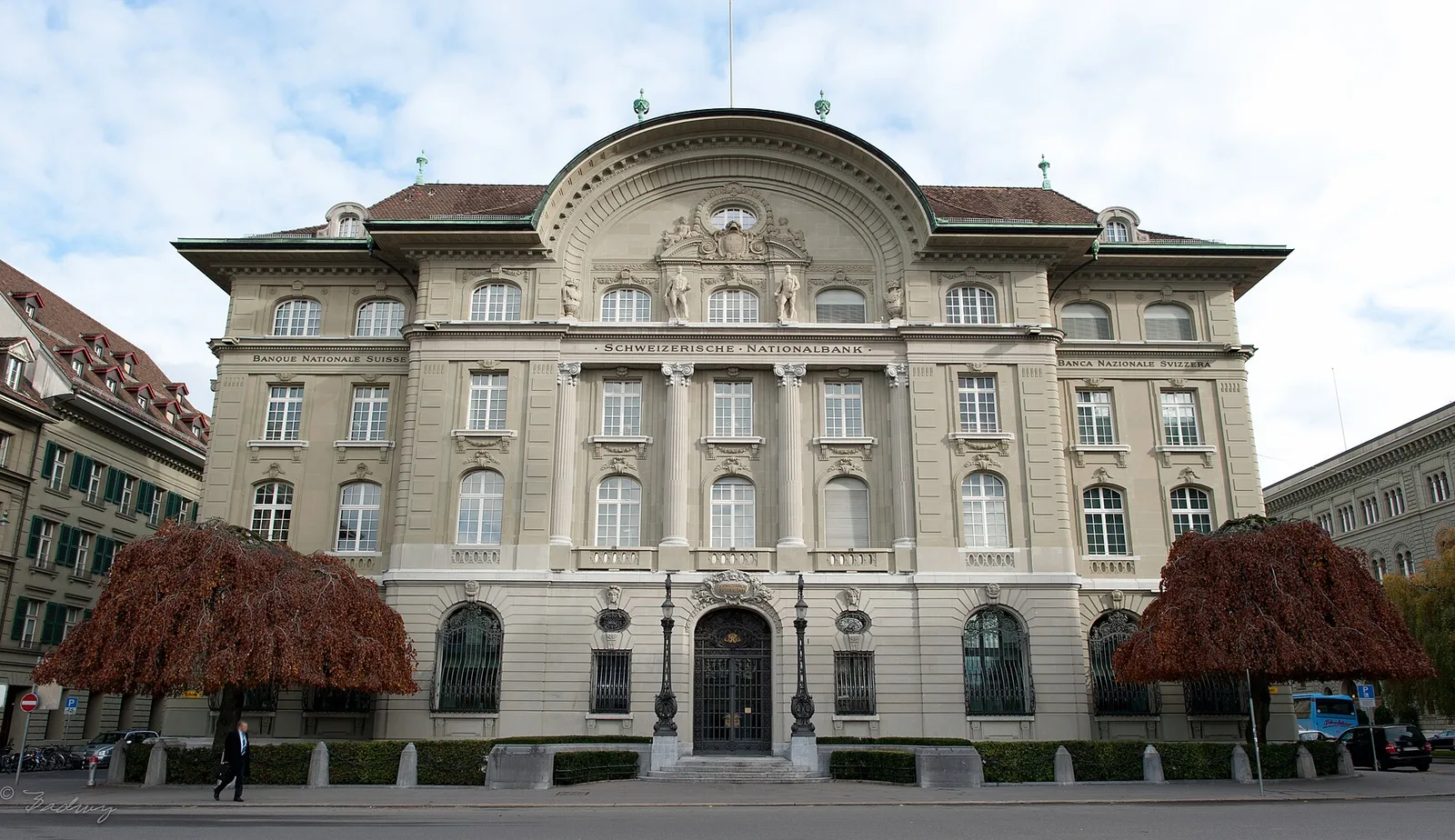
The Swiss National Bank left its policy rate at 0 percent on Thursday, holding still while central banks elsewhere tighten, and forecast that Swiss inflation will average just 0.7 percent this year. For households, that means savings rates stay low and borrowing stays cheap for some time yet.
The decision matched what economists had widely expected. The SNB also kept its tiered system for banks' sight deposits unchanged, paying the policy rate up to a threshold and 0.25 percentage points less above it, and repeated that it is prepared to intervene in the foreign exchange market as needed.
The contrast with other central banks is sharp. In its own statement the SNB noted that the euro area and the US have both raised key interest rates, and Norges Bank lifted Norway's rate to 4.50 percent at 10:00 the same morning.
Energy, Not the Home Economy, Lifted Swiss Prices
Swiss inflation rose from 0.6 percent in May to 0.8 percent in August, driven by goods prices and above all oil products. Goods inflation turned positive in August for the first time since May 2024.
Chairman Martin Schlegel said the increase was mostly energy-related and that medium-term inflation pressure had only risen slightly. The bank's new conditional forecast, which assumes the rate stays at 0 percent throughout, is a touch higher than in June, in the near term because of dearer oil products and further out partly because of the weaker franc, but it stays inside the SNB's 0 to 2 percent price stability range.
| Year | SNB inflation forecast | SNB GDP growth forecast |
|---|---|---|
| 2026 | 0.7% | 1.5% to 2% |
| 2027 | 0.8% | around 1.5% |
| 2028 | 0.8% | not given |
Growth was strong in the second quarter, although the SNB said a one-off surge in chemicals and pharmaceuticals overstated the underlying pace. Capacity use is below average, especially in manufacturing, and unemployment rose somewhat into early summer. The main risk the bank flagged is the Middle East, where a further jump in energy prices would push inflation up and slow growth.

What It Means for Savers
Swiss banks set their own savings rates, but those rates track the policy rate closely, and the policy rate has not moved. Philipp Merkt, chief investment officer at PostFinance, said the SNB is under no pressure to act and that conditions for savings and financing "remain largely stable".
The arithmetic for savers is plain. With inflation forecast at 0.7 percent this year and 0.8 percent in 2027, money held in accounts paying close to the policy rate loses a little purchasing power each year, though far less than in countries where inflation is running at 3 percent or more.
Forecasters see little change soon. A Swiss Bankers Association survey in August found that every respondent expected the rate to stay at 0 percent through 2026 and 60 percent saw no change through 2027. Nomura does not expect a first increase before 2028.
What It Means for Borrowers
The direct beneficiaries are homeowners on SARON mortgages, whose rate is built on the Swiss Average Rate Overnight. That benchmark follows the SNB policy rate, so the base cost of these loans stays near zero, with only the bank's margin on top.
Fixed-rate mortgages work differently. They are priced off longer-term market rates, which can move with global bond yields even when the SNB stands still. With yields rising in the US and Europe, borrowers fixing for many years may not see the same stability as those on SARON loans.
Merkt also sounded a warning. He said very low rates encourage borrowing and risk-taking in financial and property markets, and that the SNB's stance could shift over the coming months if the economy keeps improving. That view sits at the hawkish end of current forecasts, but it is a reminder that zero rates are not guaranteed for the life of a long mortgage.
Where Swiss households stand
- Savings rates have no reason to rise while the policy rate sits at 0 percent
- SARON mortgage costs stay near their floor, plus the lender's margin
- Fixed-rate mortgages remain exposed to global bond yields
- A weaker franc makes imports and trips abroad slightly dearer
A Weaker Franc Abroad
The franc gave up ground after the decision as the gap between Swiss and US rates widened. The dollar rose to about 0.827 francs, its highest since late May, according to FXStreet.
The SNB welcomes some of this. It said the recent depreciation supports the economy, although it also adds to medium-term inflation pressure by raising the cost of imported goods. For households, that shows up in the price of foreign products and holidays abroad.
The SNB's next scheduled monetary policy decision is on 10 December.