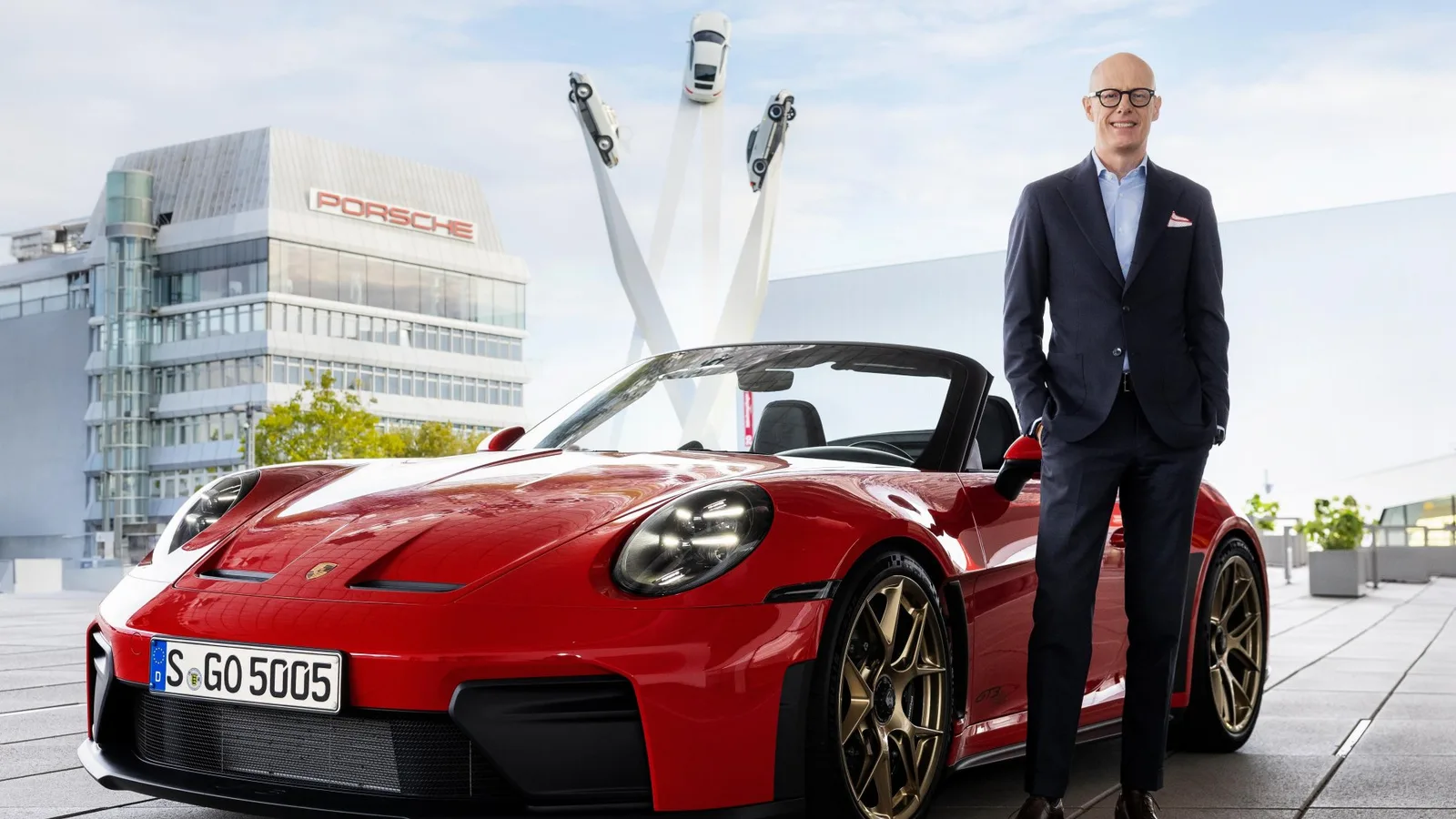
Porsche will cut 9,000 jobs by 2035, about a fifth of its workforce, and lower its break-even point to fewer than 200,000 cars a year under a new strategy built around fewer, more expensive cars. Chief executive Michael Leiters set a long-term operating margin target of 15 percent, after the figure collapsed to 1.1 percent last year.
A smaller Porsche, by design
The sports car maker set out its plan, called Sportwagenschmiede '35, at a capital markets day at its Weissach development centre near Stuttgart on Wednesday. Its central assumption is that sales will stay lower for good, so the company has to earn healthy profits on far fewer cars.
Porsche delivered 279,449 cars last year. Global deliveries have fallen almost 10 percent since the company listed in Frankfurt in 2022, as demand weakened in China and US tariffs hit another of its most important markets. Bringing the break-even point below 200,000 vehicles is meant to keep the business profitable even if volumes fall further.
Porsche calls the approach "Value over Volume". The strategy puts the 911 and luxury SUVs at the centre, pushes further into the larger, higher-margin D and E segments and raises the average selling price of top-range models by about 20 percent.
Volkswagen: share price, chart and news
The financial targets
Porsche gave targets for the medium term, which Reuters described as roughly the next five years, and for the long term.
| Target | Medium term | Long term |
|---|---|---|
| Group sales | €41bn to €45bn | Not given |
| Group operating return on sales | 10% to 15% | 15% |
| Automotive net cash flow margin | 9% to 12% | 12% |
| Dividend payout | At least 50% of net income | Not given separately |
The goals are less ambitious than those set at the 2022 listing, when Porsche, then led by Oliver Blume, aimed for Ferrari-style double-digit margins. They are also a long way from last year's 1.1 percent operating margin.
Operating return on sales is operating profit as a share of revenue. Even the bottom of the medium-term range, 10 percent on €41 billion of sales, would mean operating profit of more than €4 billion a year. The automotive net cash flow margin measures how much of car revenue is left as free cash after investment, which matters for a dividend now set at half or more of net income.
Where the savings come from
Costs carry most of the weight. Beyond the 9,000 job cuts, Porsche plans to reduce management positions by 40 percent. Investment and research and development spending are expected to peak this year and then fall significantly in the medium term.
Part of the saving comes from sharing more vehicle platforms with Audi, a fellow Volkswagen brand, which spreads development costs over more cars. Porsche is also turning back towards combustion-engine models after costly missteps with electric cars under Leiters' predecessor, Oliver Blume. Blume remains chief executive of Volkswagen, where he faces union resistance to a sweeping overhaul of his own.
The product plan still promises at least one brand-defining new model a year until 2030, including new 718 models and a new compact SUV in the B segment.
Part of a wider German car industry retreat
Porsche's cuts land in an industry under heavy pressure. Its parent Volkswagen plans about 100,000 job cuts worldwide and the closure of up to four German plants, plans that face opposition from unions. German carmakers are losing ground to low-cost Chinese rivals while tariffs complicate exports to the United States.
For Porsche, the bet is that a brand with genuine pricing power can shrink its way back to strong profitability. That depends on wealthy buyers accepting higher prices on top models at a time when its two most important markets, China and the United States, have become harder to sell into.
A muted share price response
Investors reacted calmly. Porsche shares were down 0.52 percent at €42.31 on Xetra after the presentation, suggesting that much of the restructuring had been expected.
The next checkpoint is the delivery of the cost cuts and price increases in the company's quarterly results, where investors will look for evidence that margins are recovering from last year's low.